
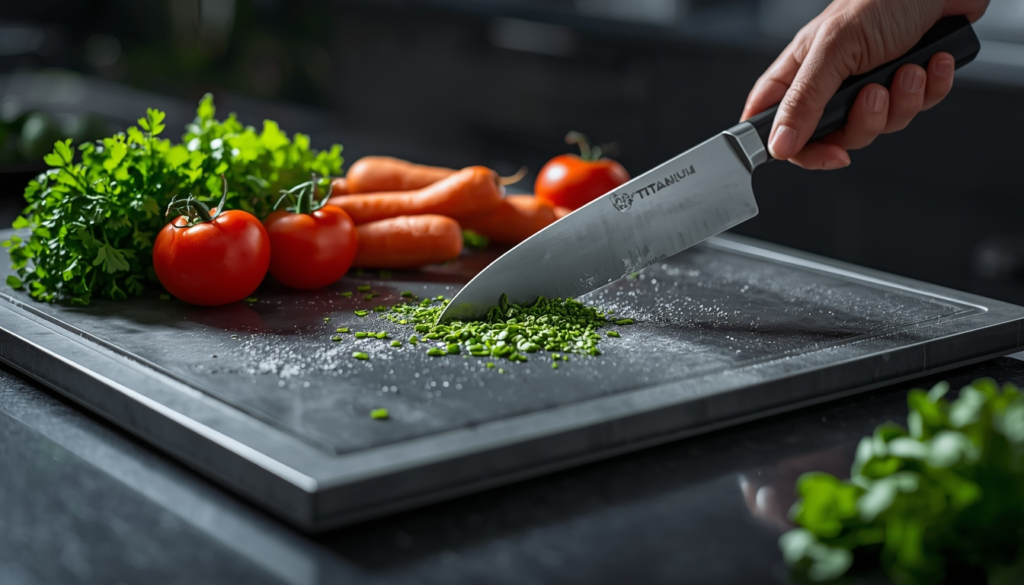
Yes titanium cutting boards are good, and this is why. Here is a number that reframes the conversation about cutting boards. According to a 2023 study published in Environmental Science & Technology. Using a plastic cutting board exposes you to between 7.4 and 50.7 grams of microplastics every single year. That is the equal to eating roughly ten credit cards worth of plastic, just from chopping your vegetables.
That finding pushed a lot of home cooks toward wood, glass, and titanium. But “titanium cutting board” has also become one of those kitchen product categories. It’s where the marketing is aggressive and the facts are harder to find. Is titanium better, or is it a premium-priced trend?
This post answers that question. You will get the science on whether titanium is safe, plus how it stacks up against wood and plastic on every dimension that matters. You will also find what the honest tradeoffs are before you spend $80–$200 on one.
Key Takeaways
- Titanium cutting boards are good for hygiene. They are non-porous, free of chemical coatings, and will never shed microplastics into your food.
- A landmark 2023 study found plastic cutting boards release 7.4–50.7 grams of microplastics per person every year. A very good reason to reconsider your current board.
- Titanium is FDA-compliant for food contact and is the most biocompatible metal on Earth. It’s used in surgical implants, joint replacements, and pacemakers.
- The real tradeoff is knife wear: titanium is harder on blade edges than wood, which remains the gold standard for knife-friendly daily prep.
- Many products sold as “titanium” are actually coated steel. If you buy one, verify grade and purity certification before spending the money.
Are Titanium Cutting Boards Any Good?

Yes, titanium cutting boards are genuinely good. But “good” depends entirely on what you are optimizing for.
If your priority is a chemically inert surface that will never leach toxins, never absorb bacteria, and never need replacing, titanium delivers on all three. If your priority is keeping your kitchen knives sharp with minimal maintenance, wood is still the better choice.
Titanium checks real boxes that other materials cannot. It is non-porous, meaning bacteria and food residue have nowhere to hide. It contains no BPA, no PFAS, no chemical coatings that can chip or degrade. And unlike plastic, it produces zero microplastics during use, because there is no polymer matrix to shave apart.
I spent some time butchering, chopping frozen meats with a cliver. I noticed on occasion pieces of plastic would fly free from the board because of the strength i used. Some pieces even got into the meats, safety was an issue. It was this that prompted me to try out different kinds of cutting boards. I needed one which held up to the pressures I was putting it under on a daily basis.
The catch is that titanium is not the ideal daily driver for everyone. It is harder on knife edges than wood, it can be noisy during use, and many of the cheapest options on the market are not actually titanium at all. More on all three of those in a moment.
Are Titanium Cutting Boards Better Than Wood or Plastic?
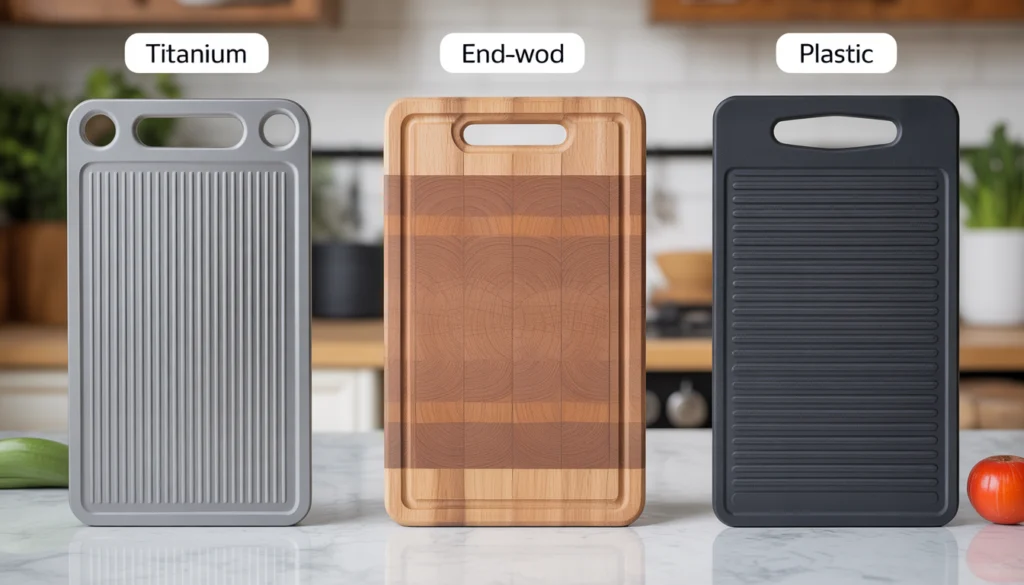
Titanium is better than plastic for health and hygiene. It is roughly equal to wood on hygiene when both are well-maintained, but worse than wood for knife longevity.
The honest comparison looks like this:
| Feature | Titanium | Wood | Plastic |
|---|---|---|---|
| Microplastic shedding | None | None | 7.4–50.7g/year (polyethylene) |
| Chemical leaching | None | None | BPA, PFAS risk |
| Bacteria resistance | Non-porous, naturally resistant | Porous, requires maintenance | Non-porous, but grooves trap bacteria |
| Knife friendliness | Moderate (accelerates edge wear) | Excellent (especially end-grain) | Good |
| Durability | Lifetime — does not crack or warp | Years — requires oiling, can crack | Months to years — grooves deepen |
| Ease of cleaning | Very easy, dishwasher safe | Hand-wash only, requires oiling | Easy, dishwasher safe |
| Cost | High ($80–$200+) | Low to medium ($20–$80) | Low ($10–$40) |
A 2025 study in Environmental Health Perspectives concluded this. “No plastic cutting boards can be considered entirely safe”. It was after mice fed food prepared on plastic boards developed intestinal inflammation and gut microbiome disruption. Wood boards did not produce the same effects.
Where titanium clearly wins is on the plastic comparison. The microplastic issue is not hypothetical. Research from the University of North Dakota found this. Cutting carrots on a plastic board generates as many as 15 microplastic particles per cut. That adds up fast across a week of meal prep.
Where wood holds its own is on daily cooking feel. End-grain wood boards in particular are widely considered the top choice for knife health. Because the blade slips between the wood fibers rather than grinding against a hard surface. Titanium does not offer that. Knife edges need more frequent honing when titanium is the regular prep surface.
[Checkout wood cutting boards for knife]
Why Would Anyone Want a Titanium Cutting Board?
People want titanium cutting boards. Because they solve the three biggest long-term problems with traditional boards. For example chemical contamination, bacterial buildup, and replacement cost.
The appeal becomes clearer when you think about what happens to your cutting board over time, not just on day one.
Plastic boards develop grooves. Those grooves are where bacteria thrive, and they are essentially impossible to fully sanitize once deep enough. The Food Safety Committee recommends replacing grooved plastic boards immediately for exactly this reason. That means ongoing cost and ongoing waste.
Wood boards need regular oiling to prevent cracking, they absorb moisture, and they cannot be put in the dishwasher. A well-maintained wood board is genuinely safe, but “well-maintained” takes consistent effort. Skip the oiling for a few months and you have a cracked, bacteria-prone surface.
Titanium has neither problem. It does not groove meaningfully under normal use, does not absorb moisture and does not need oiling. A simple wash with soap and water is enough to sanitize it. It can withstand high-temperature cleaning without warping or degrading.
For people who have started paying attention to what their cookware is made of. The same people swapping Teflon pans for stainless and filtered tap water for bottled. Titanium is the logical next step for the cutting board.
In my expierience it’s great for busy families, or people with health-conscious diets or allergies. In professional kitchens i see this being used in kitchen sections where ready to eat food is prepared. Food coming out of these areas are rarely cooked like salads and appetizers. More caution should be shown around these foods.
Is It Healthy to Use a Titanium Cutting Board?
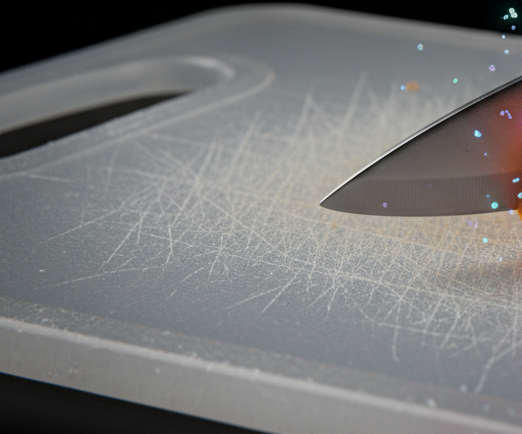
Yes. Pure titanium is one of the safest materials that can contact food. It does not leach chemicals, does not react with acidic foods, and releases nothing during cutting.
The strongest evidence for this comes not from the kitchenware industry but from medicine. Titanium has been used in surgical implants since the 1950s. It is the material of choice for hip replacements, knee joints, pacemaker casings, dental implants, and spinal fusion cages. These are all situations where the material must remain completely inert inside a living human body for decades.
The reason titanium behaves this way is a natural phenomenon called passivation. When titanium is exposed to oxygen, it instantly forms a thin, stable layer of titanium dioxide (TiO₂) on its surface. That oxide layer is chemically inert and self-healing: if scratched, it reforms within milliseconds. It is this layer that prevents any reaction between the metal and the food, liquid, or cleaning agent it contacts.
In leaching studies, titanium released just 0.009 parts per million into cooking solutions, the lowest figure of any metal tested. For context, even high-quality stainless steel releases measurably more.
From a regulatory standpoint, pure titanium and titanium nitride (TiN) coatings are FDA-compliant for food contact. TiN was approved for food-contact applications in packaging materials under Food Contact Notification 2252.
The practical implication
You can prep acidic foods like tomatoes and citrus, raw proteins, and anything else without any concern. No longer worring about the board contaminating what you are cutting. That is not something you can say with the same confidence about older or heavily used plastic boards.
[Checkout non-toxic kitchen cutting board]
Are Titanium Cutting Boards the Healthiest Option Available?
On the axis of chemical safety and contamination risk. Yes titanium is the healthiest cutting board material currently available. On the broader picture of kitchen health, it depends on how you define “healthy.”
The healthiest cutting board is the one that puts the least unwanted material into your food. On that measure, the ranking is clear:
Plastic is the worst option by a significant margin. A 2023 peer-reviewed study in Environmental Science & Technology quantified this. Annual microplastic exposure from polyethylene boards at 7.4–50.7 grams per person, and from polypropylene boards at 49.5 grams per person. A 2025 follow-up study in Environmental Health Perspectives showed their findings. Those particles cause measurable intestinal inflammation and gut microbiome changes in animal models
Wood performs well when properly maintained. A study comparing plastic and wood boards found this. Mice fed food prepared on wooden boards did not experience the inflammatory effects seen with plastic. The risk with wood is bacterial contamination from poor maintenance. A porous, cracked, or un-oiled board can harbor pathogens.
Titanium adds nothing to food and takes nothing away. Zero microplastics, zero chemical leaching, zero reactive compounds from contact with acidic or alkaline ingredients. It is the cleanest surface-to-food contact of the three.
Where “healthiest” gets complicated is the knife question. Dull knives cause more hand injuries than sharp ones. If titanium is wearing your knives faster, and you are not compensating with regular honing. Then there is a downstream safety consideration in the kitchen worth factoring in.
The honest answer: for toxin-free food prep, titanium wins. For the total kitchen experience including knife health and maintenance habits. A combination of a quality wood board for daily prep and a titanium board for raw proteins. That with a thorough sanitization may actually be the best setup.
The One Thing Titanium Cutting Boards Do Not Do Well
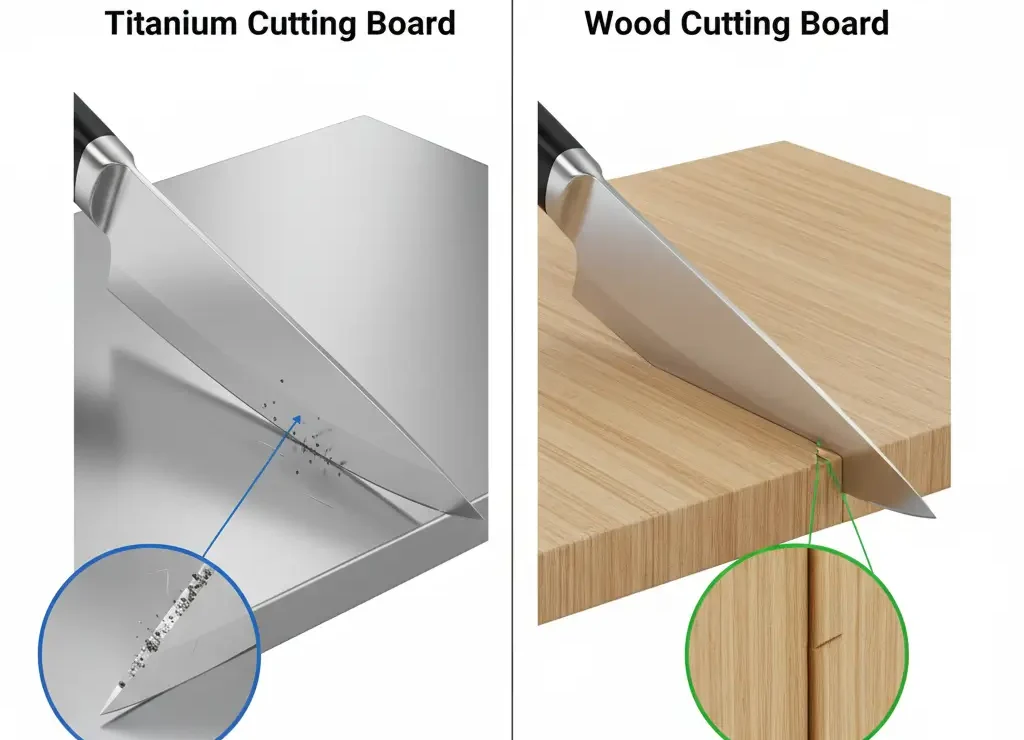
Titanium cutting boards speed up knife edge wear more than wood does. This is a real tradeoff worth knowing before you buy.
Most quality kitchen knives measure between 55 and 62 HRC on the Rockwell hardness scale. Titanium comes in around 36 HRC, softer than the steel in your knife blade, which sounds like it should be fine for the edge. And compared to glass or ceramic boards, which will destroy a knife edge in short order, titanium is genuinely more forgiving.
But compared to a good wood board, it is harder on edges. A knife cutting on end-grain wood slips between the fibers; there is very little lateral resistance at the edge. On titanium, there is consistent surface contact with a non-yielding material. Over time, that adds up to a blade that needs more frequent honing and periodic sharpening.
According to Vivront, a knife-care focused review site that tested titanium boards. “In our experience when using titanium boards, knives need more regular maintenance.” They note that end-grain wood boards remain the clear top answer for anyone whose priority is knife longevity.
This is not a dealbreaker, but it is information the product marketing tends to gloss over. If you have a high-end knife collection and minimal interest in frequent sharpening, a titanium board as your only board may frustrate you. If you are happy to hone weekly and sharpen every few months, it is a non-issue.
What to Look for When Buying a Titanium Cutting Board
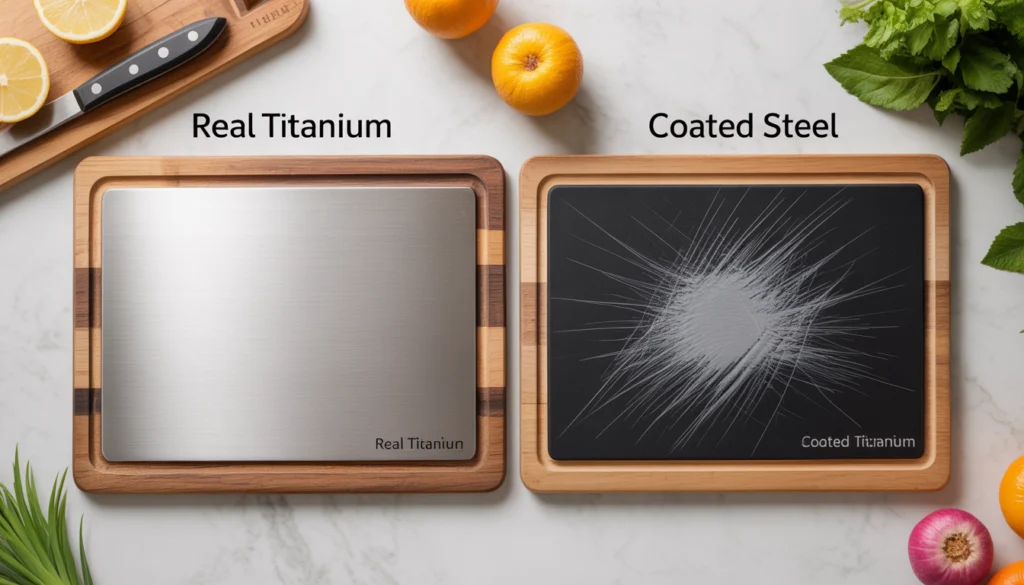
Here is the single most important thing to know. Many products sold as titanium cutting boards are not actually made from titanium. They are coated steel, often with a titanium nitride surface finish that gives the appearance. But you will not get the full material properties of solid titanium.
That does not make them unsafe. TiN coatings are FDA-compliant and used in medical devices. It does mean you are not getting the same material you are paying for, and the durability and property claims on the marketing page may not hold.
Here is what to look for:
Purity certification. Legitimate titanium board manufacturers provide third-party lab certification (often SGS certification) verifying 99%+ pure titanium and FDA food-contact compliance. If a brand cannot provide this documentation, treat the product with skepticism.
Grade matters. Grade 1 commercially pure titanium (99.5%+ purity) is the grade used in medical implants and the most biocompatible option. The othe Grade 2 is also acceptable but contains slightly more trace elements. Lower grades or unspecified “titanium alloys” introduce variables worth questioning.
Realistic pricing. Pure titanium is genuinely expensive and difficult to work with at scale. A $20 “titanium” cutting board is almost certainly not solid titanium. Expect to pay $80 and upward for a board from a brand that can back up its claims with documentation.
Size and grip. Titanium surfaces can be slippery compared to textured wood. Look for boards with non-slip feet or a rubberized underside. Especially if you prep proteins where stability under pressure matters.
I know this to be important. Our counter tops at work are made of metal. They are strong and easy to clean, but very slippery when wet not at all stable for a cutting board. Stability can be achieved by placing a damp cloth or damp layers of tissue beneath it.
FAQ
Are titanium cutting boards dishwasher safe?
Yes. Unlike wood, titanium will not warp, crack, or absorb moisture in a dishwasher. High-temperature cleaning cycles are perfectly safe and will not degrade the surface. Most brands confirm dishwasher compatibility without restrictions.
Do titanium cutting boards rust?
No. Titanium does not rust or corrode. The natural TiO₂ oxide layer that forms on its surface is chemically stable and self-healing. It’s resistant to both moisture and cleaning agents that would corrode lesser metals.
Can titanium leach metal into food?
In leaching studies, titanium released just 0.009 parts per million into cooking solutions — effectively zero. It does not react with acidic foods like citrus or tomatoes, unlike some other metals.
Are titanium cutting boards worth the price?
They are worth the price if hygiene and long-term durability are your primary concerns. A quality titanium board costs more upfront but never needs replacing, never needs oiling, and never degrades into your food. If budget is the constraint, a well-maintained end-grain wood board is a more affordable alternative. It has a similar health profile when used correctly.
How do I clean a titanium cutting board?
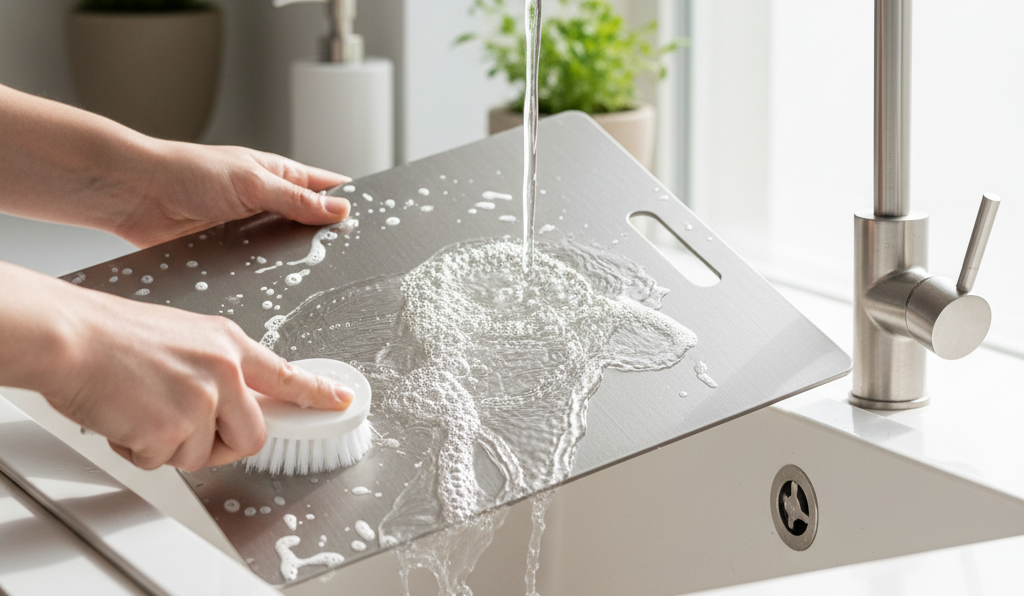
Warm water and mild dish soap is enough for everyday cleaning. For deeper sanitizing, a baking soda paste (baking soda mixed with water, left for 15 minutes, then rinsed) removes stubborn stains and odors. Avoid harsh abrasive scrubbers that could scratch the surface finish, and avoid bleach-based cleaners. These are unnecessary and may affect the surface over time.
Is a titanium cutting board better for raw meat?
Yes, titanium has a non-porous surface. It means bacteria from raw meat cannot penetrate the board the way they can with grooved plastic or porous wood. It sanitizes fully with a basic wash, and can tolerate high-heat sterilization without degrading. This makes it an excellent dedicated board for raw proteins.
Can a titanium cutting board dull my knives?
It is harder on knife edges than wood, but more forgiving than glass or ceramic. If you use a titanium board daily, plan on honing your knives once or twice a week and sharpening a few times per year. Pairing it with a wood board for delicate prep work is a practical solution.
Conclusion
Titanium cutting boards are genuinely good. They are not a gimmick. The science behind the microplastic problem with plastic boards is real. The biocompatibility of titanium is well-documented. The core promise is a surface that adds nothing to your food and lasts indefinitely, holds up.
The honest summary of where they fit:
- They are the healthiest option if eliminating chemical contamination is the priority.
- They are not the best option if knife longevity is the priority, that remains wood.
- A two-board system (wood for daily prep, titanium for raw proteins and rigorous cleaning) is the setup that gets you the most out of both.
- If you buy one, verify the purity certification. A lot of what is sold as “titanium” is not.
If you are ready to explore specific options. Start with the certified brands that publish third-party lab results. That transparency is the clearest signal that you are actually getting what you are paying for.
Sources
- Gan, H. et al. (2025). Simulated Microplastic Release from Cutting Boards and Evaluation of Intestinal Inflammation and Gut Microbiota in Mice. Environmental Health Perspectives. https://pmc.ncbi.nlm.nih.gov/articles/PMC11980920/
- KitchePicks. (2025). Are Titanium Cutting Boards Food Safe? FDA & Toxicity Facts. https://kitchepicks.com/are-titanium-cutting-boards-food-safe/
- Wikipedia. Titanium Biocompatibility. https://en.wikipedia.org/wiki/Titanium_biocompatibility
- Vivront. (2026). Titanium Cutting Boards: Are They Worth It? (Honest Review). https://vivront.com/blogs/news/titanium-cutting-boards-are-they-worth-it-for-everyday-cooking
- Environmental Working Group. (2023). Making Meals Without Microplastics: Tips for Safer Cutting Boards. https://www.ewg.org/news-insights/news/2023/10/making-meals-without-microplastics-tips-safer-cutting-boards
- Valtcan. (2026). Is Titanium Cookware Safe? Science-Backed Guide to Pure Titanium Safety. https://www.valtcan.com/blogs/valtcan-blog/is-titanium-cookware-safe