
Key Takeaways
- Titanium cookware is considered safe, because it is chemically stable and non-reactive.
- It does not release toxins or harmful fumes under normal cooking temperatures.
- High-quality titanium cookware does not leach measurable amounts of metal into food.
- Titanium has strong biocompatibility. The main reason it’s widely used in medical implants with minimal health risk.
- Concerns about titanium dioxide do not apply to solid titanium cookware.
Introduction
Over 1,000 titanium implants are placed in human bodies every single day. There used in hip replacements, dental posts, surgical plates. This material has been stress-tested inside the human body at a level no cookware ever will be. So when people ask me whether their titanium skillet is poisoning them, I want to start there.
That said, the worry is understandable. We’ve all seen the headlines about Teflon fumes killing pet birds, or the slow drip of aluminum into acidic sauces. People are right to scrutinize what touches their food. The problem is that “titanium” is getting lumped in with a separate material, titanium dioxide. This has its own controversy as a food additive. Those are two very different things, and conflating them causes a lot of unnecessary panic.
Here’s what you actually need to know about titanium cookware safety, backed by the science.
Is Titanium Cookware Safe?
Yes. Titanium cookware is safe for cooking under normal conditions. It is chemically inert, does not react with food, and is recognized as a food-contact-safe material by major regulatory bodies.
What “Safe Cookware” Actually Means
When we talk about safe cookware, we’re asking three questions: Does it release toxic compounds into food? Does it off-gas harmful fumes when heated? And does long-term use create a meaningful health risk? A material has to fail on at least one of those fronts to be concerning.
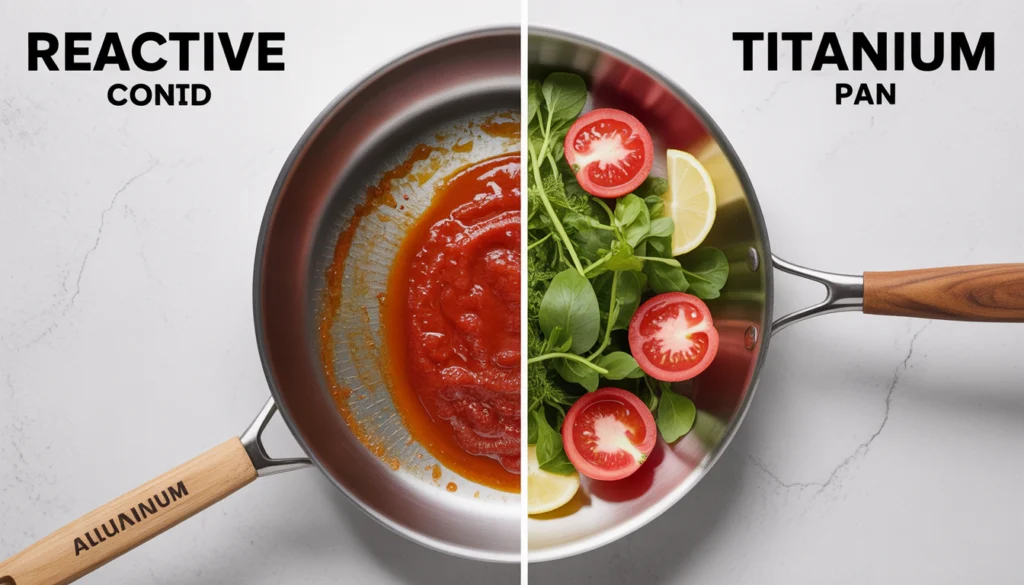
Non-reactivity is the foundation of safe cookware. Materials like aluminum and uncoated copper react with acidic foods like tomatoes, citrus and vinegar. The reaction releases metal ions into your meal. Titanium doesn’t do this. It forms a passive oxide layer on its surface that makes it resistant to chemical attack. That’s not marketing language. It’s the same property that makes titanium the material of choice for offshore oil rigs and marine equipment exposed to saltwater.
Why Titanium Is a Stable Cooking Material
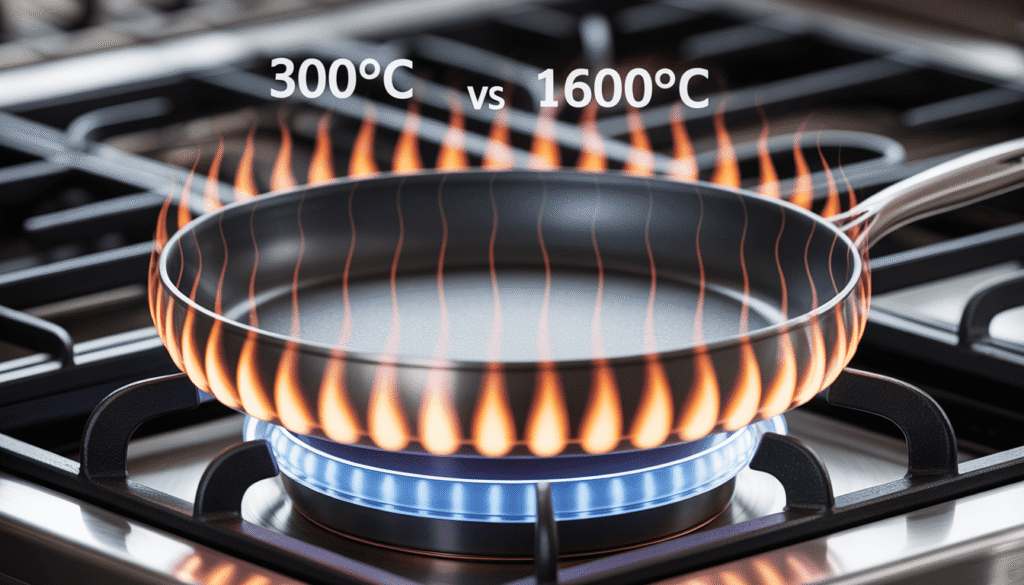
Titanium’s stability comes down to its corrosion resistance and chemical inertness. The material sits at a melting point of 1,668°C (3,034°F). Your stovetop, even at highiest heat, reaches somewhere between 260°C and 370°C. You are nowhere near the conditions that would begin to degrade the metal. Learn more at CPSC / Industry Materials Safety Data Sheets for Titanium
Regulatory and Safety Approvals
The U.S. Food and Drug Administration has approved titanium for use in food-contact applications. Globally, titanium is food-safe. This is why it shows up in commercial food processing equipment, cutlery, and cookware. See more at FDA Food Contact Substances Database.
Titanium earned this status because decades of data show it doesn’t meaningfully interact with food.
Is Titanium Cookware Safe for Health?
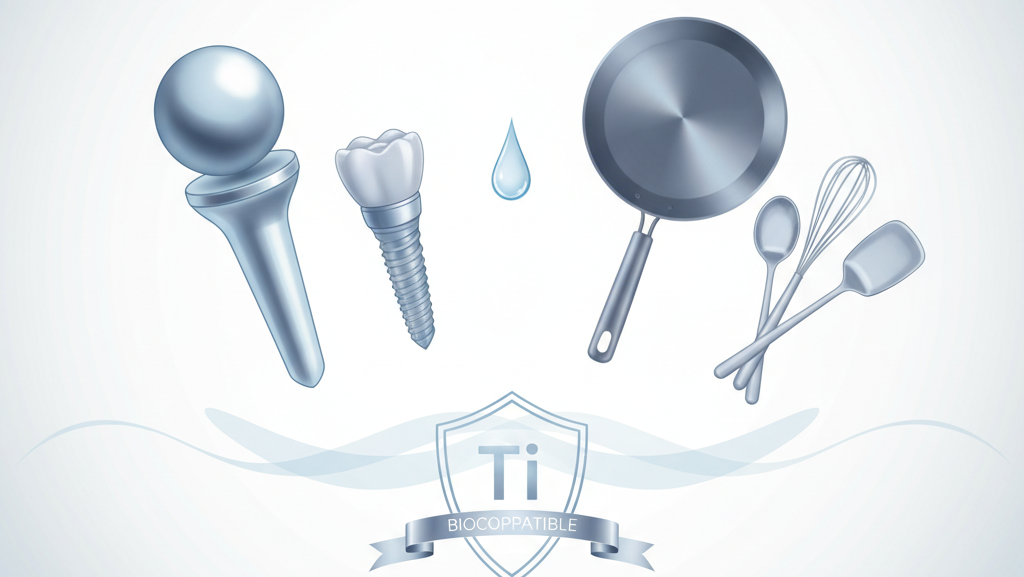
Yes. Titanium has a well-documented safety profile in humans, supported by decades of medical research. The human body absorbs very little of it. The amount it does absorb is handled without adverse effects.
How the Human Body Interacts with Titanium
Biocompatibility refers to a material’s ability to interact with biological systems without causing harm. Titanium scores very high here. According to studies compiled by the National Institutes of Health. Titanium is minimally absorbed when in contact with human tissue. The little that does enter the bloodstream is largely excreted without accumulating in organs. Learn more at NIH, Titanium Toxicity and Biocompatibility Studies.
The Agency for Toxic Substances and Disease Registry (ATSDR) describes titanium as this. It has low toxicity and minimal systemic absorption in its Toxicological Profile for Titanium. That profile documents that even workers in industries with heavy titanium dust exposure don’t show patterns of systemic harm consistent with the material itself. For more on this click ATSDR Toxicological Profile for Titanium.
Evidence from Medical and Scientific Use
Here’s the most compelling real-world data point. Titanium has been implanted in human bodies for over 60 years. Joint replacements, dental implants, cardiac pacemaker casings, spinal rods. These devices sit inside people indefinitely, in direct contact with blood and tissue, and the medical consensus is that they are safe. If titanium were meaningfully toxic at the biological level, we’d know by now. Find more info at Journal of Biomedical Materials Research, “Biocompatibility of Titanium”.
Compare that to cookware, where your exposure is indirect, brief, and at far lower surface contact than a hip replacement. The risk profile doesn’t get more favorable than that.
Everyday Exposure vs. Harmful Exposure Levels
The World Health Organization notes that typical human titanium exposure, through food and environmental sources, is low and not associated with adverse health outcomes. Read more at WHO Titanium Exposure Data.
We’ve already been exposed to trace titanium through soil, water and food. Cookware doesn’t meaningfully change that picture.
Does Titanium Cookware Release Toxins When Heated?
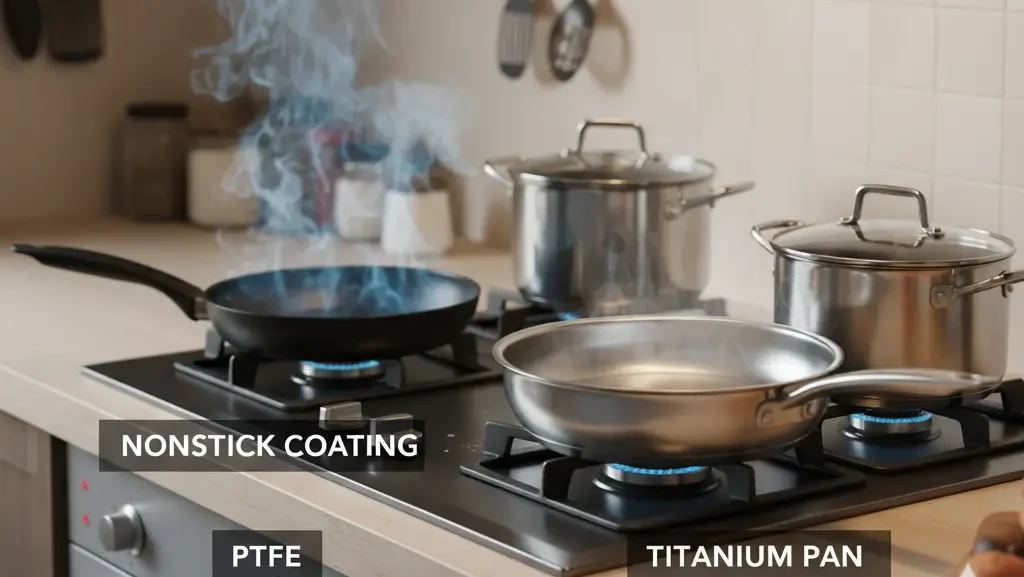
No. Pure titanium cookware does not release toxic compounds or fumes at normal cooking temperatures. The thermal stability of titanium makes this a non-issue under any realistic kitchen scenario.
Thermal Stability of Titanium
Here why nonstick coatings (particularly older PTFE/Teflon coatings) raised alarms. They begin to degrade at around 260°C and release harmful compounds at higher temperatures. Titanium metal begins to degrade at over 1,600°C. The gap between your wok on high heat and the conditions needed to destabilize titanium is enormous. For futher info check CPSC / Industry MSDS for Titanium.
Comparison With Other Cookware Materials
| Material | Reactive with Acidic Foods? | Releases Fumes When Overheated? | Leaching Risk |
|---|---|---|---|
| Pure Titanium | No | No (stable to 1,668°C) | Very Low |
| Stainless Steel (high quality) | Minimal | No | Low to Moderate |
| Aluminum (uncoated) | Yes | No | Moderate |
| Nonstick (PTFE-coated) | No | Yes (above 260°C) | Low (coating intact) |
| Cast Iron | Minimal | No | Low (iron, not toxic) |
| Copper (uncoated) | Yes | No | High |
I have been using aluminium for many years. The reason I liked using it is because of how fast it heats up. When cooking food to serve as it is odered. The faster your pan gets hot, the sooner the meal can be prepared to serve. But when you cook for people with allergies or certain dietary dos and donts you must always look at cookware type. This was what picked my interest in titanium. It’s nonreactive and wont leech into what I’m cooking.
The single most important distinction in the cookware safety conversation is this. Titanium metal and titanium dioxide are not the same thing. Solid titanium cookware poses none of the concerns raised about titanium dioxide nanoparticles as a food additive.
Is Titanium Toxic When Heated?
No. Heated titanium does not become toxic under cooking conditions. Toxicity from titanium requires industrial-level exposure, far beyond anything a kitchen can produce.
What “Toxicity” Means in Material Science
Toxicity is dose-dependent. Even water is toxic in enough quantity. The question for any material is: at what exposure level does harm occur, and does normal use approach that level? For titanium, the gap between “normal use” and “harmful exposure” is so large that the ATSDR classifies it as a low-toxicity material.
Scientific Findings on Heated Titanium
No peer-reviewed evidence links heated titanium cookware to toxic fume exposure or food contamination at cooking temperatures. The material’s oxide layer remains intact and stable under heat. What you’re cooking in stays on the food side, what’s in the pan stays in the pan.
Misconceptions About Metal Cookware Toxicity
The confusion usually starts with nonstick coatings. These coatings are used in some titanium-labeled cookware. Here’s where you need to read labels carefully. Some products marketed as “titanium cookware” are actually aluminum or steel pans with a titanium-infused nonstick coating.
That coating, not the titanium itself, is what drives any safety concern. Pure titanium cookware with no coating is an entirely different product. If you’re looking for a deeper breakdown of what to look for when buying, see our guide to choosing non-toxic cookware materials.
Does Titanium Cookware Leach Chemicals Into Food?
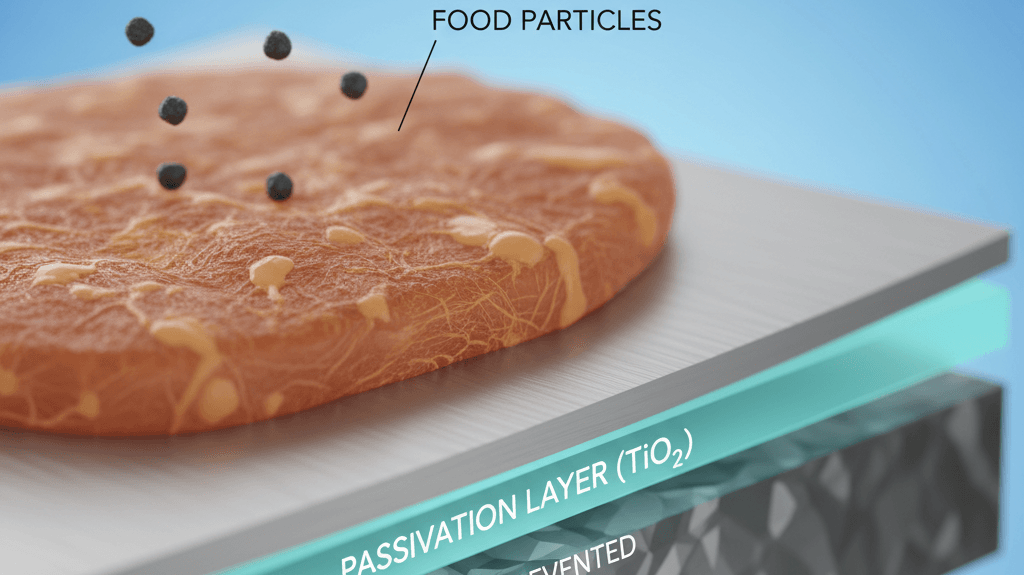
No. High-quality titanium cookware does not leach meaningful amounts of metal into food, even with acidic ingredients. Its corrosion resistance is among the highest of any cookware material.
What Leaching Is and When It Happens
Leaching is the process by which a metal releases ions or particles into food during cooking. It’s accelerated by heat, acidity and physical damage to the surface. Aluminum leaches into tomato sauce. Uncoated copper leaches into everything. The degree to which a material leaches depends entirely on its reactivity.
Titanium’s Resistance to Leaching
According to environmental and materials studies on metal leaching in cookware. Pure titanium and high-quality titanium alloys show negligible leaching. Especially compared to aluminum or copper, particularly under cooking conditions. You can learn more here Scientific Reports / Environmental Studies on Metal Leaching in Cookware.
The passive oxide layer that forms on titanium’s surface is the key. It acts as a barrier between the metal and your food. That layer doesn’t dissolve in vinegar, tomato, or citrus. Hence it’s use in food processing equipment. They may need to handle highly acidic products at industrial scale.
Factors That Could Influence Leaching
Three things are worth keeping in mind:
- Coatings: If your pan has a nonstick coating on top of titanium (or on top of something else labeled as titanium), the coating’s integrity matters. A scratched nonstick coating is a separate issue from the titanium underneath.
- Alloy quality: Not all titanium cookware is pure titanium. Lower-grade alloys may include other metals. Buying from reputable manufacturers with verified material standards matters.
- Surface damage: Severe physical damage to any metal surface can theoretically increase exposure. With titanium, this risk is still very low, but it’s reason enough to avoid metal utensils on coated products.
For a practical comparison of how titanium stacks up against stainless steel. See our titanium cookware breakdown.
What Does Titanium Do to the Brain?
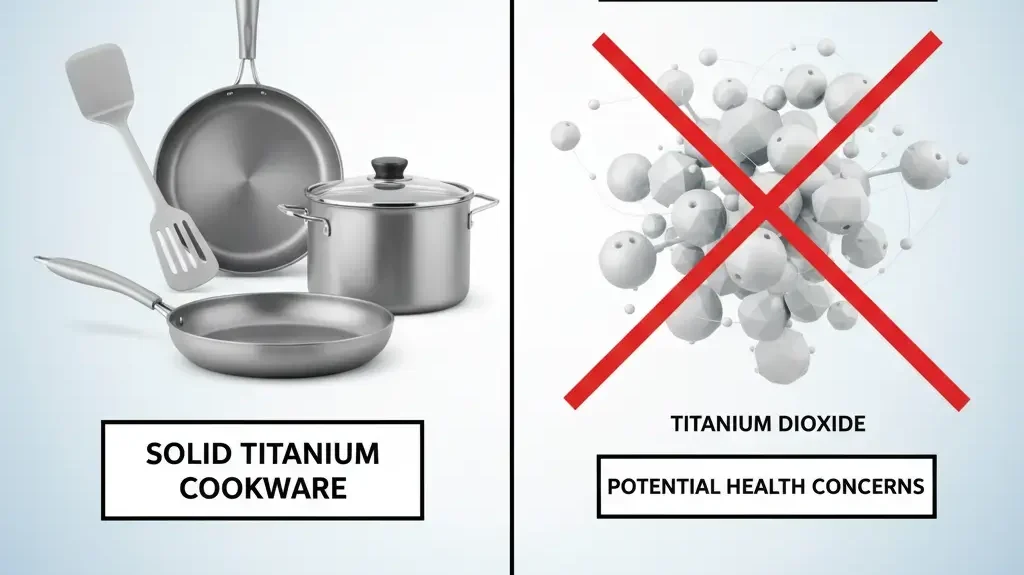
Current scientific evidence does not link titanium cookware use to any neurological harm. Concerns about titanium and brain health stem from confusion with titanium dioxide nanoparticles, not solid titanium.
Current Scientific Understanding of Titanium in the Body
The body does not efficiently absorb titanium. The minimal absorption does not cross the blood-brain barrier in significant quantities under normal exposure conditions. The NIH’s biocompatibility data confirms this. Titanium in implant form (which creates far more sustained contact than cookware) does not produce neurological side effects in the general population. For more see NIH, Titanium Toxicity and Biocompatibility Studies.
Differentiating Titanium Metal vs. Nanoparticles
This is the critical distinction. Titanium dioxide (TiO2) nanoparticles, are used as a food whitening agent in some processed foods and candies. They are are where legitimate neurological concern enters the conversation. The European Food Safety Authority’s 2021 review raised concerns about TiO2 as a food additive. Nanoparticles behave differently in the body than bulk material. Learn more at EFSA Titanium Dioxide Safety Review, 2021.
Solid titanium cookware does not contain nanoparticles. It is a bulk metal. The EFSA concern about TiO2 does not translate to solid titanium cookware. They are chemically related but physically and behaviorally different products.
What Are the Signs of Titanium Toxicity?
Genuine titanium toxicity is rare and almost only documented in industrial or implant-related contexts, not cookware use. Recognizing the difference between documented risk and theoretical risk matters here.
Documented Cases of Titanium Sensitivity
A small number of people have documented titanium allergies, most often surfacing after dental or orthopedic implant procedures. Symptoms include localized inflammation, skin reactions, or implant loosening. These cases are rare, and they involve sustained, direct bodily contact with titanium, not dietary exposure.
Symptoms Reported in Extreme Exposure Scenarios
Long periods exposed to Industrial titanium dust has been linked with pulmonary irritation. This refers to lung inflammation from inhaled particles. This is an occupational health issue relevant to factory workers, not home cooks.
Why Cookware Use Does Not Trigger Toxicity
Your exposure from titanium cookware is indirect (metal to food to you), intermittent (only during cooking), and at trace levels the body handles without issue. The exposure levels documented in adverse event cases are orders of size higher than anything a kitchen produces. If you’re curious about how different cookware materials compare on long-term safety, read our full cookware matirals guide.
FAQs about Is Titanium Cookware Safe?
Is titanium cookware better than stainless steel for safety?
Both are considered safe. But titanium has a slight edge in corrosion resistance and is lighter. High-quality 18/10 stainless steel is also a solid, low-leaching choice. Whats important are build quality and whether any more coatings are involved.
Can titanium cookware cause metal poisoning?
No, there has not been metal poisoning from titanium cookware found. Titanium’s low reactivity means it does not release ions into food at levels that would cause harm.
Is titanium dioxide in cookware dangerous?
Titanium dioxide is a separate compound from the titanium metal used in cookware. Some nonstick coatings include titanium dioxide particles for hardness. This is distinct from the EFSA concerns about TiO2 nanoparticles as a food additive.
Does scratched titanium cookware become unsafe?
For pure titanium, scratches increase surface area but don’t change safety, since the metal itself is inert. For coated pans marketed as “titanium,” a scratched nonstick surface is a different concern depending on what the coating contains.
Is titanium cookware safe for acidic foods?
Yes. Titanium is highly resistant to acidic environments. Unlike aluminum or copper, it does not react with tomatoes, citrus, or vinegar-based dishes.
Conclusion
The short answer is yes, titanium cookware is safe. The longer answer is that it’s safe. Because of specific, well-understood material properties that have been tested in far more demanding environments than your kitchen. Medical implants inside human bodies for 60 years. Industrial food processing exposed to aggressive acids. Marine equipment in saltwater. Titanium has a track record that most cookware materials simply don’t.
The main thing to be careful about is the label. “Titanium cookware” can mean a pure titanium pan, or it can mean a steel pan with a titanium-infused coating. Those are different products with different safety profiles. Know what you’re buying, source from manufacturers who are transparent about materials, and you’re in good shape.