
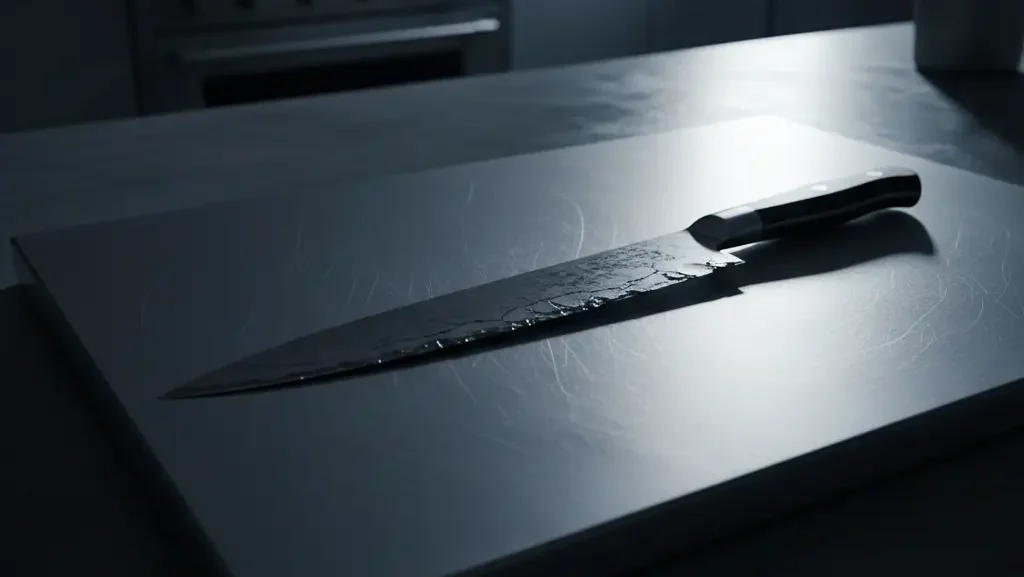
Did you know a sharpened knife has an edge measuring 3 to 5 microns thick? That is thinner than a human hair. This micro geometry is what allows a high-quality chef’s knives to slice effortlessly through tough ingredients. A sharp blade reduces the unnecessary strain on your wrists while chopping.
Right now, social media is aggressively pushing a massive trend for kitchen tools. Marketers are selling solid titanium cutting boards as the ultimate kitchen accessories. They promise a pristine, medical-grade long-lasting surface. It prevents you from eating the plastics shed by standard plastic boards.
The problem is that this titanware trend completely ignores the delicate physics of everyday knife work. I have watched home cooks ruin knives worth hundreds of dollars simply because they switched to metal cutting surfaces. Using rigid metal boards with expensive knives shortens their blade lifespan drastically.
I am going to break down exactly why titanium performs so poorly for knife health. We will cover the actual physics behind knife dulling. Also how abrasive boards cause rapid dulling, and the exact board material you should be using instead.
Key Takeaways
- Titanium cutting boards will dull knives faster than wood or plastic boards. It’s because the metal surface has absolutely no give to absorb the impact of the blade.
- Even though knife steel is harder than pure titanium. The thin geometry of a blade edge will fold or shatter when struck against solid metal.
- Western knives suffer from edge rolling on rigid metal. Harder Japanese-style knives will suffer from micro chipping and structural damage.
- Titanium boards are popular because they offer a non-porous surface. The surface eliminates micro plastics, but you should only use them with lower-quality blades.
- End-grain wood and high-density rubber boards remain the absolute best choices for protecting your kitchen knives.
Do titanium cutting boards dull knives faster than wood or plastic?
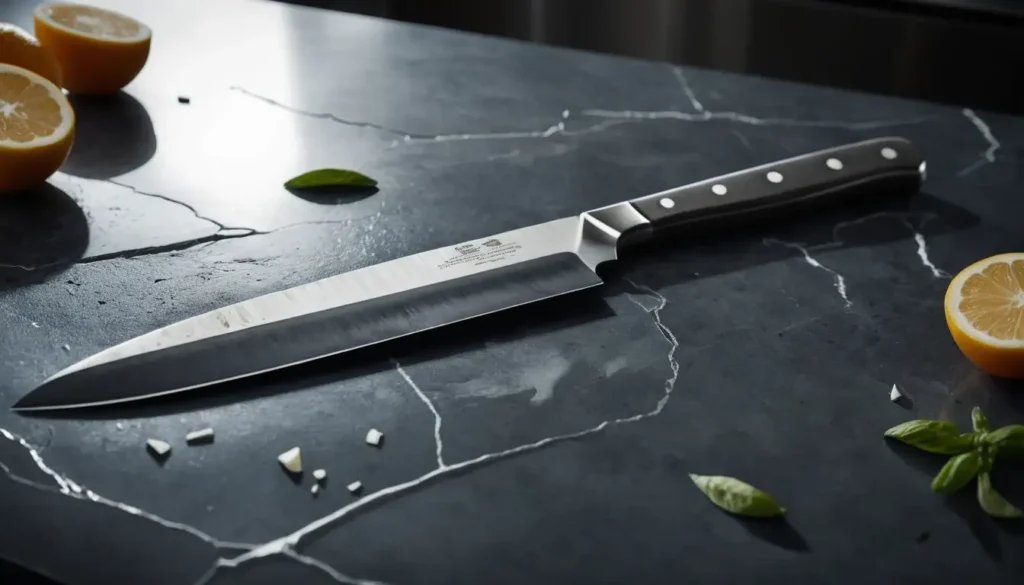
Yes, titanium cutting boards dull knives faster than wood or plastic cutting boards. The density and nature of the metal surface destroys the microscopic edge blades upon impact. Finding a knife friendly titanium board is physically impossible. Check out the article on knife sharpening and maintenance.
The give factor: Why surface compliance matters
When you cut an onion, your knife passes through the food and strikes the board below. A proper cutting board must have a certain amount of surface compliance to absorb that kinetic energy. Wood fibers naturally part, and soft plastic compresses slightly to cradle the sharp steel. This friction reduction is vital for proper knife care.
Titanium offers absolutely zero compression. When your knife edge contacts a metal block, the energy from the downward swing has nowhere to go. The board refuses to absorb the shock, meaning 100 percent of the impact force is sent directly back into the cutting equipment. That weak point is the microscopic edge of your well-made knife.
The Hardness Myth: Titanium vs. Kitchen Knife Steel
Commercially pure titanium typically registers around 35 to 40 on the Rockwell hardness spectrum. Standard kitchen knife steel sits much higher at 55 to 64 HRC. Despite hardened steel being harder on paper. The sheer density of the titanium board causes thinner knives to fail upon contact.
If knife steel is harder, why does the knife lose?
People argue that because steel knives are harder than titanium alloys, the board cannot hurt the blade. This misunderstands the hardness reality of a cutting edge. Your blade style tapers down to a fraction of a millimeter to create a sharp part. When that paper-thin sliver of hard materials slams into a massive flat slab of metal, the thinner material always loses.
According to [Source: MatWeb Material Property Data], titanium possesses a vastly higher density compared to any traditional materials like wood or rubber. It acts like an anvil. Despite its softer-than-steel structure, striking it causes immediate surface wear on the knife. You would never cut vegetables on a solid anvil and expect your quality blades to survive a single slicing session.
Material Hardness Comparison
| Material | Approximate Rockwell Hardness (HRC) | Surface Compliance (Give) | Edge Damage Risk |
|---|---|---|---|
| End-Grain Wood | N/A (Far below HRC scale) | High | Very Low |
| Soft Plastic (HDPE) | N/A (Far below HRC scale) | Medium | Low |
| Pure Titanium | 35 – 40 HRC | None | Extreme |
| Western Knife Steel | 55 – 58 HRC | N/A (The cutting tool) | N/A |
| Japanese Knife Steel | 60 – 64 HRC | N/A (The cutting tool) | N/A |
The Golden Rule of Cutting Boards:
If the material is hard enough to make a loud clack when you tap it with the spine of your knife, it is too hard for your blades. Never use ceramic boards, glass, stone, or any hard surfaces.
What physically happens to your knife on a metal board?
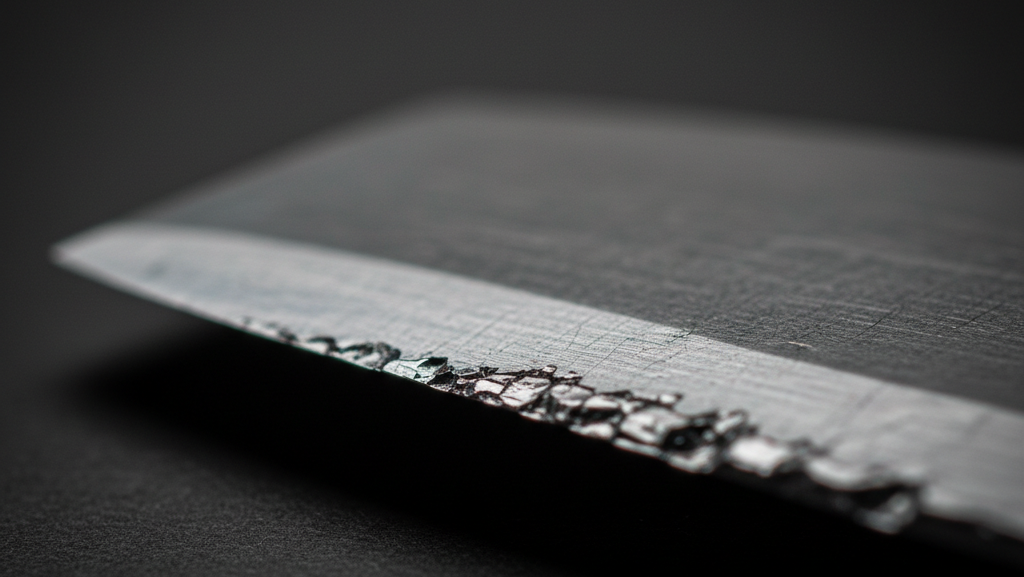
When a knife strikes a solid metal surface, the blade experiences either plastic deformation or abrasive wear. The exact type of damage depends entirely on the specific hardness and brittleness of your knife steel. A bad surface can ruin a fresh blade overnight.
I remmber boring my nakiri knife to another staff in the kitchen without asking what she was planning to cut. She ended up using it as a butcher’s cleaver to cut chicken wings on a titanium cutting board. She returned the knife with a ruined edge. The knifes edge had chips and folds in certain locations. A nakiri knife is made for cutting vegetables, that why it has a thin blade. Despite the simularities to a cleaver, it was not designed for such abuse.
Edge rolling (Plastic Deformation)
Heavy-duty knives from Western brands use a slightly softer steel alloy that is usually hardened to around 56 to 58 HRC. This specific quality stainless steel formulation is designed to bend rather than break under pressure.
When these flexible blades hit titanium surfaces, the microscopic knife edges. It folds over themselves. Metallurgists call this plastic deformation, but in the kitchen, we call it edge rolling. The knife feels completely blunt. You are no longer cutting with the sharp apex of the steel, but rather dragging the folded metal across your ingredients.
Micro-chipping (Abrasive Wear)
Japanese style knives use high carbon steel hardened to 60 HRC or above. According to official guidelines, you should never use these premium tools on metal or ceramic.
Because high-carbon steel is so hard, it is incredibly brittle. It refuses to bend. When this brittle carbon steel impacts titanium boards, the thin edge shatters. This violent collision leaves microscopic chips missing from the blades entirely. You cannot simply bend a chipped edge back into place.
If they destroy knives, why are titanium cutting boards so popular?
Titanium cutting boards provide a sterile, low-friction surface that completely eliminates the risk of ingesting micro plastics. Consumers are willingly trading knife longevity for perceived health benefits. People choose titanium because they misunderstand how different materials affect their kitchen equipment.
The plastics fear (Plastic boards)
Many plastics have dominated home kitchens for decades. Unfortunately, every time you use plastic cutting boards, you carve small knife marks into the surface. This mechanical action releases thousands of tiny polymer particles into your food over the lifespan of the board.
People are rightfully terrified of consuming these particles. Titanium works well as an alternative because a knife cannot carve deep grooves into the harder surface. No deep grooves mean no physical material is shedding into your food.
The bacteria fear (Wood boards)
Wood cutting boards need strict maintenance and can absorb stains if they are not cleaned properly. Titanium, is the exact same material used for medical implants. It is completely sterile and corrosion resistant.
According to data non-porous metal surfaces are completely resistant to bacterial absorption. You can slice raw meat on a titanium board, wash it with hot soapy water, and instantly know it is safe. There are no deep cuts for bacteria to hide in. Read more on titanium cutting boards.
Are there any safe ways to use a titanium cutting board?
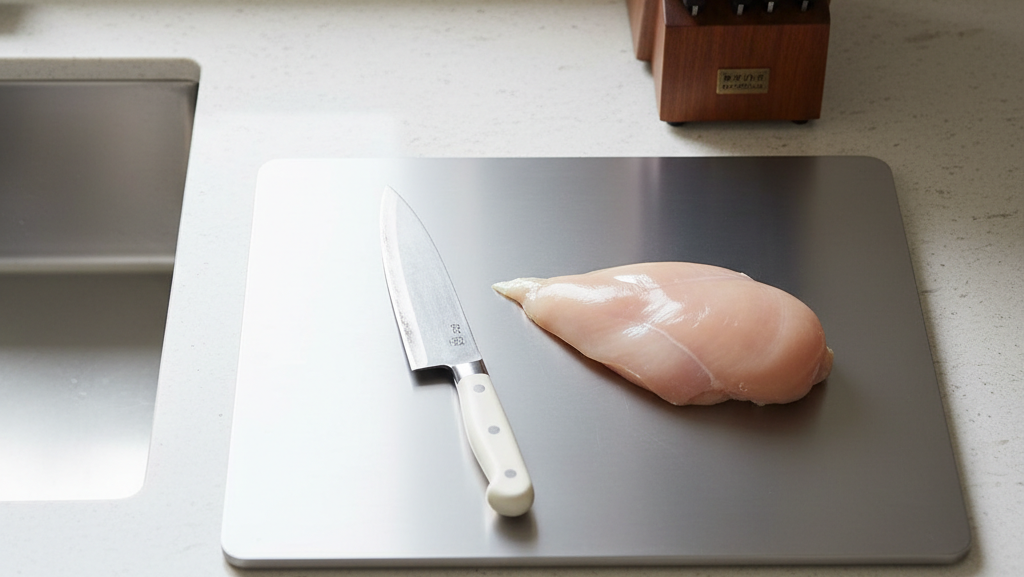
The only safe way to use a titanium board is to reserve it strictly as one of your temporary surfaces for raw meat preparation. While only using an appropriate knife of lower quality. You should never allow well-made knives to touch a metal surface under any circumstances.
The Beater Knife strategy for raw meat
I completely understand the appeal of having a perfectly sterile board for raw poultry. If you already fell for the viral marketing, do not throw your titanware away. Keep it tucked next to the sink for high-risk proteins and treat it like your secondary surfaces.
Go out and buy a cheap commercial kitchen knife. Use that specific beater knife only on the titanium board. Expect the blade to need frequent sharpening. You can either fix it with extra sharpening sessions or simply replace it when it becomes a safety hazard. Keep your quality knives far away from the rigid metal.
How to fix a knife dulled by a metal cutting board
To fix a knife dulled by metal, you must use a honing rod to realign a rolled edge, or a whetstone to grind away the steel and create a completely new edge. The material issue dictates the repair method. Metal boards create the need for far too many sharpenings.
If you used softer steel knives and suffered from edge rolling, a honing rod will fix the problem. Run the blade down the rod at a consistent angle. The friction grabs the folded burr and bends it back into a straight apex. Occasional sharpening is normal, but metal boards need constant work.
If you used a hard Japanese-style knife and suffered from cracking or micro chipping, a honing rod is useless. The steel is physically gone. You have to take the knife to a coarse whetstone and grind the entire edge down until you pass the structural damage. This removes steel permanently and drastically shortens your blade lifespan. Here is a step-by-step tutorial on how to use a whetstone for beginners.
The Best Alternatives to Titanium (That Protect Knives and Health)
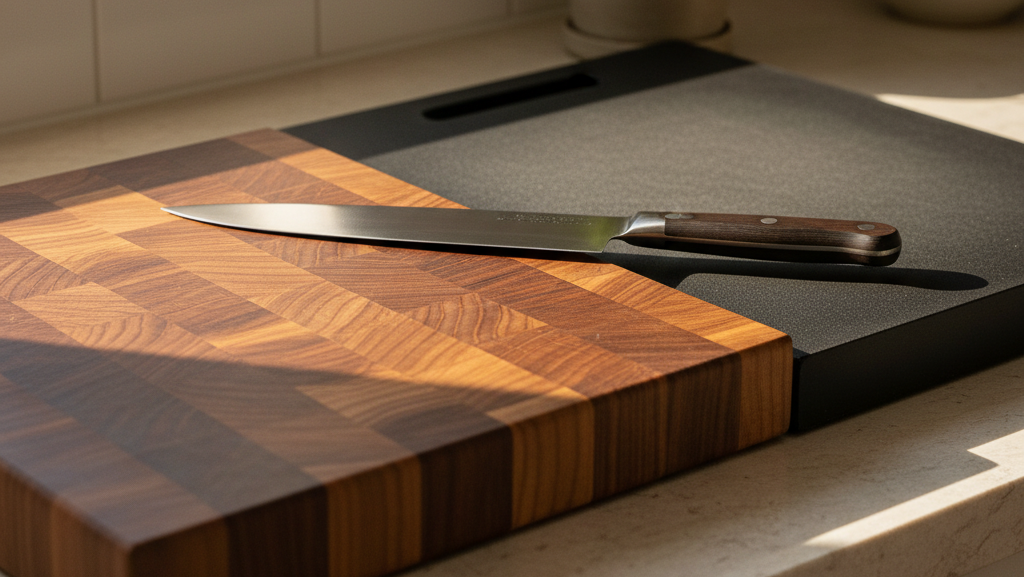
The absolute best alternatives to titanium are end-grain wood blocks or high-density rubber boards. These different board materials provide the necessary give to protect your knives while offering excellent longevity. You need surfaces prioritizing knife friendliness.
End-grain wood (The gold standard)
End-grain wood is the historical gold standard for primary cutting boards. Instead of laying wood planks flat, an end-grain board faces the wood fibers directly upward. Picture a tightly packed bundle of straws.
When your knife edge slices down into an end-grain board, the wood fibers gently part to absorb the blade. When you lift the knife, the fibers naturally push back together. This self-healing property provides incredible knife protection. It also keeps your blade sharpness pristine for months. Learn more on best wood for cutting boards.
High-density rubber/TPU (The modern compromise)
If you desperately want to avoid plastics but hate the heavy oiling required by wood, look at professional rubber boards. Brands like Hasegawa and Asahi dominate sushi kitchens around the world for a reason. Knife makers highly recommend them.
They use synthetic rubber compounds over a wood core. According to ASTM International, these specific materials offer a density perfectly balanced to absorb violent impacts. They do not shed toxic particles, they preserve knife health, and many are dishwasher safe.
FAQ
Are titanium cutting boards better than stainless steel?
Both titanium and stainless steel are terrible for blades and will cause rapid dulls or chipping. However, titanium is lighter than stainless and offers superior corrosion resistance. It’s slightly easier to handle in the kitchen.
Does a titanium cutting board leave a metallic taste on food?
No, titanium does not leave a metallic taste on your food. It is a highly unreactive metal that will not leach flavors, stains, or chemicals into acidic ingredients like tomatoes.
Can you put a titanium cutting board in the dishwasher?
Yes, you can safely put a titanium cutting board in the dishwasher. The intense heat and harsh detergents will not warp or cause corrosion to the solid metal.
Next Steps for Your Kitchen
Titanium cutting boards are a brilliant solution for food safety but a catastrophic nightmare for kitchen tools. The viral marketing campaigns conveniently leave out the fact that metal-on-metal impact will destroy expensive knives in a matter of days. Because knife performance matters for safety, you must avoid hard materials.
If you value your culinary equipment, stop using metal cutting surfaces immediately.
Your next step is simple. Audit your kitchen today. Relegate your titanium surfaces only to raw chicken duty with cheap blades. Then, invest in a high-quality end-grain wood block or a Japanese rubber board for your everyday prep. Your chef’s knives will stay razor-sharp, and your cooking experience will be infinitely better.
Sources:
- MatWeb Material Property Data: Verified the hardness spectrum and impact resistance of commercially pure titanium compared to hardened steel and plastics.
- Serious Eats (Culinary Science): Documented the mechanics of blade retention and the micro geometry of culinary tools.
- Shun Cutlery / Wüsthof Care Guidelines: Official manufacturer warnings against using high-carbon knives on metal, ceramic, or stone surfaces.
- Journal of Food Protection: Provided clinical data demonstrating why non-porous surfaces are highly resistant to bacterial absorption.
- Metallurgical Science (Edge Rolling): Detailed the specific physical differences between plastic deformation and abrasive wear on different materials.
- ASTM International: Supplied density standards explaining how rubber boards absorb impact without shedding particles.