
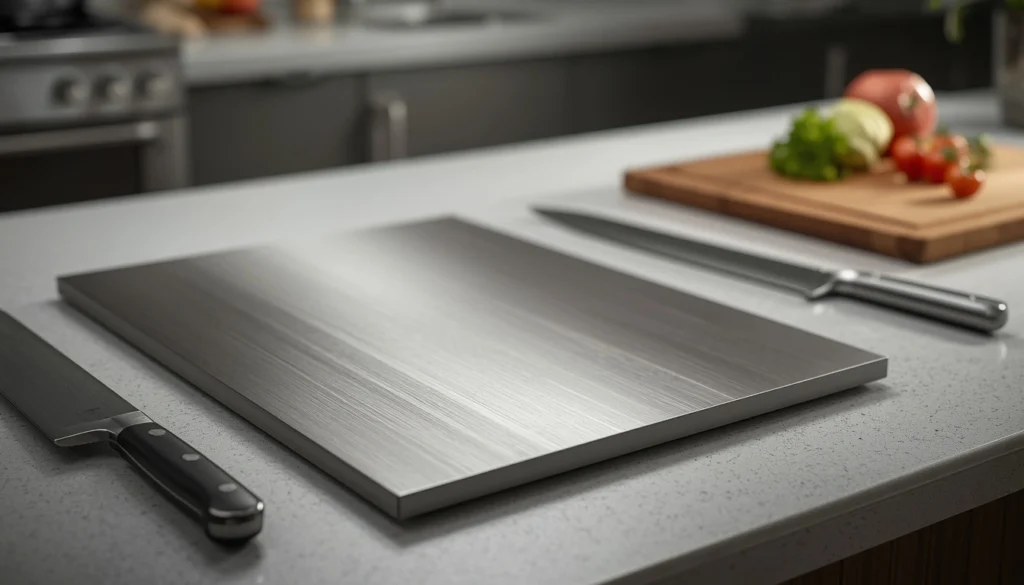
Key Takeaways
- Titanium cutting boards dull knives faster than wood or plastic. Independent testing found titanium to be the single worst cutting board material for knife edge retention.
- Most “titanium” boards use a TiN (Titanium Nitride) coating that measures up to 2,500 HV, roughly 4 times harder than the steel in your kitchen knives.
- They are loud. Chopping on titanium produces a harsh metallic clang. If you cook in shared spaces or early in the morning, this matters.
- Professional chefs generally avoid them for daily chopping. Most prefer end-grain wood or color-coded plastic boards for everyday kitchen work.
- Titanium boards make more sense as a specialty surface. They are useful for hygiene-critical tasks or as a secondary board, rather than your go-to cutting surface.
Titanium rates around 6 on the Mohs hardness scale. That puts it in roughly the same range as the steel in your kitchen knives. So when you chop on a titanium board, you’re dragging one hard metal across another. That means your knife’s edge pays the price.
That one fact cuts through a lot of the hype around titanium cutting boards. These boards are everywhere on social media right now, with influencers calling them the “last cutting board you’ll ever need.” And they do have real advantages: they’re non-porous, easy to clean, and won’t warp or crack. But the drawbacks are just as real, and they don’t get nearly as much attention.
In this post, I’ll walk through every significant downside of titanium cutting boards. It’s backed by independent testing and material science data. All this so you can decide whether one belongs in your kitchen. I’ll also share what professional chefs actually think of them, which might surprise you.
What Are the Drawbacks of Titanium Cutting Boards?
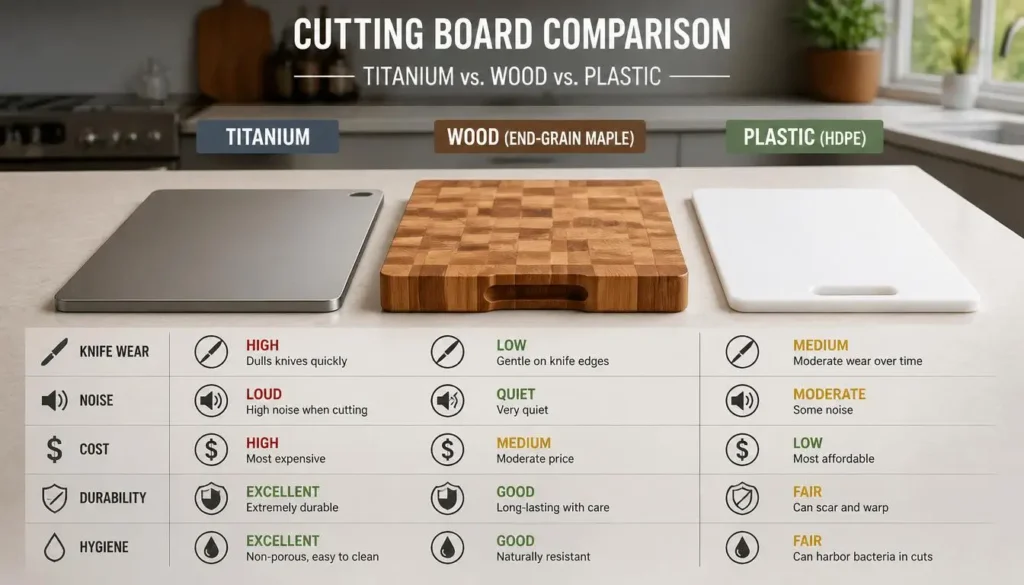
The main drawbacks of titanium cutting boards are knife dulling, loud noise during use, a slippery surface, high cost, and limited availability. These aren’t minor quirks for most home cooks. They add up to a board that causes more daily frustration than it solves.
Here’s a quick summary before we go deeper into each one:
| Factor | Rating | Notes |
|---|---|---|
| Knife friendliness | Poor | Fastest dulling of any board material tested |
| Noise level | High | Loud metallic clang on every chop |
| Surface grip | Slippery | Smooth metal surface; food and board can slide |
| Cost | High | Significantly more expensive than wood or plastic |
| Hygiene | Excellent | Non-porous; won’t absorb bacteria or odors |
| Durability | Excellent | Won’t warp, crack, or stain |
| Maintenance | Easy | Dishwasher safe; no oiling required |
The pattern is clear. Where titanium wins, it wins big. Where it loses, it loses in ways that affect you every single time you pick up a knife.
Do Titanium Cutting Boards Dull Your Knives?
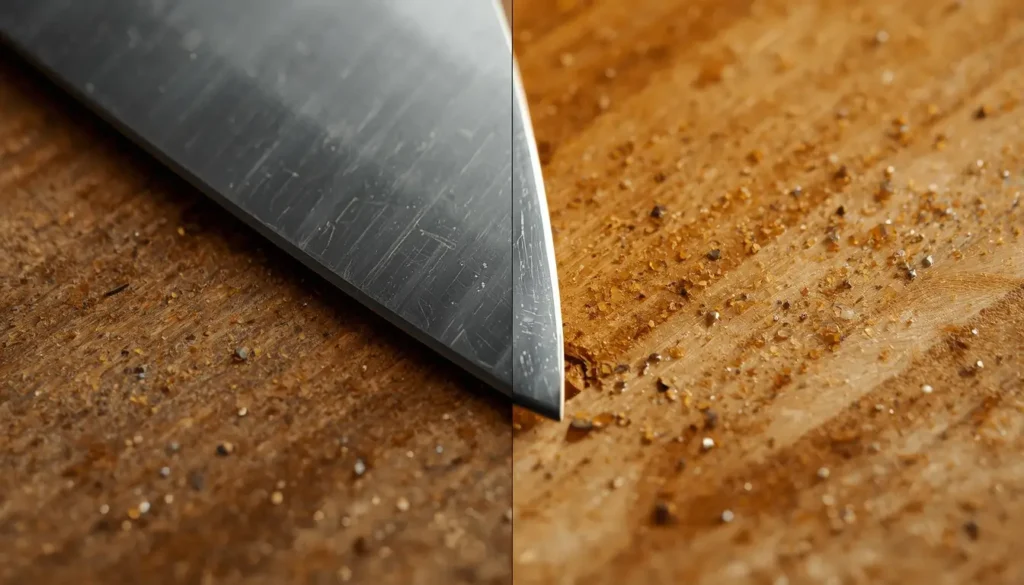
Yes, titanium cutting boards dull knives faster than wood or plastic, and independent testing confirms it. This is the most important con to understand before you buy one, especially if you’ve invested in good knives.
The Science Behind the Dulling Problem
Knife dulling comes down to what happens when two hard surfaces meet. A knife’s edge is microscopically thin, and it stays sharp when it can bite slightly into the cutting surface below it. Wood fibers compress and give way. Plastic offers a little cushion. Titanium gives nothing, it pushes back.
According to testing data from Walker Metalsmith. Titanium alloys measure between 330–380 HV (Vickers Hardness), compared to maple wood at just 20–30 HV and HDPE plastic at around 60–70 HV. That means titanium is roughly 10 to 15 times harder than the plastic boards most people use every day. [Source: Walker Metalsmith]
It’s not only hardness, though. As Koppenhouse explains, knife dulling on titanium also results from adhesive and frictional wear. So when a knife edge slides across a metal surface, the metal-on-metal contact generates fine abrasive friction. The friction chips the edge at a microscopic level, even if the board is technically softer than the knife steel. [Source: Koppenhouse]
If you’re using Japanese chef knives with harder, thinner edges (typically 60–67 HRC), this frictional wear is even more of a problem. Harder steel can be more brittle, and micro-chipping on a hard surface accelerates edge breakdown.
TiN-Coated Boards vs. Pure Titanium: Which Is Worse?
Here’s something most buyers don’t realize: the majority of boards marketed as “titanium” aren’t solid titanium at all. They use a Titanium Nitride (TiN) coating over a stainless steel base. TiN is the gold, bronze, or rainbow-colored finish you see on many of these boards.
That coating is dramatically harder than pure titanium. According to Kitchepicks, TiN coatings measure 2,000–2,500 HV — approximately 4 times harder than hardened knife steel. Pure titanium, by contrast, sits around 36 HRC on the Rockwell scale, which is softer than most kitchen knives. [Source: Kitchepicks]
Most important takeaway: If you’re buying a titanium cutting board, check whether it’s solid titanium or a TiN-coated board. The coating is far more damaging to knife edges than the base metal itself.
The practical upshot: if you own quality knives, a TiN-coated board will force you to sharpen them much more frequently. If you’re already using a whetstone or other sharpening tool regularly, this adds real time and cost to your kitchen routine.
The Noise Problem Nobody Talks About
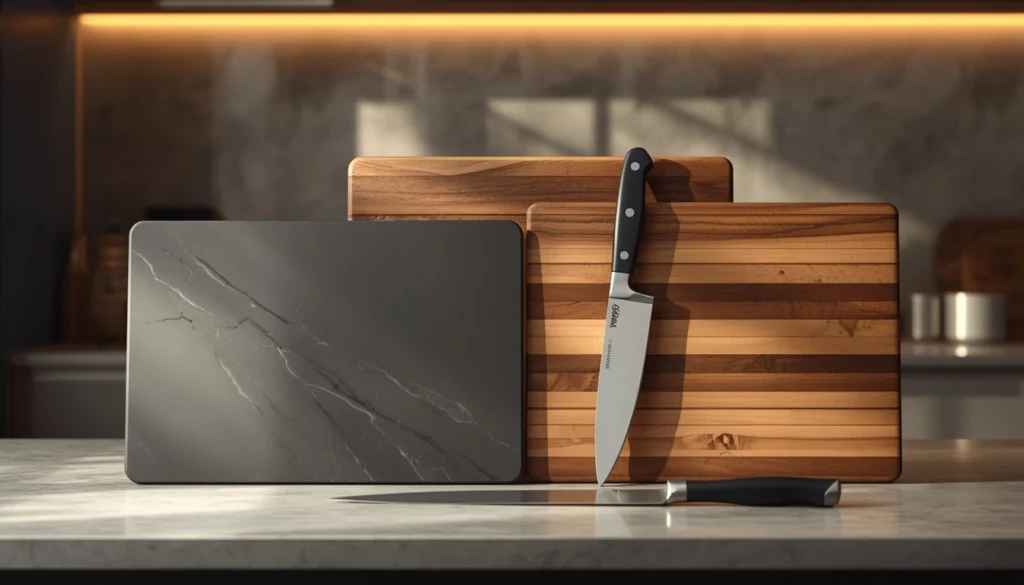
Titanium cutting boards are loud, not mildly loud, but noticeably, unpleasantly loud. This is the second-biggest drawback of titanium boards, and it’s one most reviews bury in the fine print.
Prudent Reviews tested this directly. They recorded the sound level of chopping and rocking motions across many board materials. Both titanium and stainless steel boards were the loudest by a wide margin. Every chop produced a harsh metallic clang, and sliding a knife across the surface created a sound described as like nails on a chalkboard. [Source: Prudent Reviews]
Wood and plastic absorb some of the impact energy from each chop. Titanium reflects it all back, which is exactly why the noise is so sharp and penetrating. If you cook early in the morning, in an open-plan kitchen, or with other people nearby, this becomes a daily irritation, not a minor one.
Why Titanium Cutting Boards Are So Expensive
Titanium cutting boards cost significantly more than comparable wood or plastic options. A quality end-grain walnut board from a brand like Boos might run $80–$150. A titanium board in a similar size starts higher and can reach well above $100 for mid-range options, with premium versions going higher still.
Part of the price is the raw material, titanium is genuinely expensive to produce and machine. But part of it is also branding: titanium carries a premium, high-tech image that the pricing reflects. As TitanCuttingBoard notes, the higher price may not align with everyone’s budget or perceived value. Especially when the board’s biggest selling points (hygiene, durability) are also available in a good end-grain wood board. This board happens to be gentler on your knives. [Source: TitanCuttingBoard]
Availability is a related issue. You generally can’t walk into a local kitchen store and pick one up. Most titanium boards are sold online only, which makes it harder to assess build quality before you buy.
The Slippery Surface Issue
Titanium’s smooth, non-porous surface is great for hygiene. But it also means both the food and the board itself can slide during use. This is a safety concern, not just a convenience issue.
Wood boards, especially end-grain ones, have a slight texture that grips the countertop. It provides resistance when you’re pressing down on food. Plastic boards grip reasonably well too. A polished titanium surface offers almost none of that natural friction. Many titanium boards try to solve this with rubber feet or a silicone rim. Those features help, but they add to the cost and still don’t fully replicate the feel of a surface with natural grip.
For cooks who are still building knife skills, or anyone cutting small or round items like cherry tomatoes or shallots. An unstable surface isn’t only annoying, it’s a real hazard. If you’re thinking about cutting board safety in a home kitchen, this one deserves more weight than it usually gets. You can read more about how to safely use cutting boards to see why surface stability matters for everyday prep work.
What Do Chefs Actually Say About Titanium Cutting Boards?
Most professional chefs don’t use titanium boards as their primary cutting surface. This is one of the most telling signals about where titanium fits in a real kitchen.
I use titanium boards only when preparing food for customers who have allergies. I really like it’s strength and the garuntee you will not get any foriegn bacteria in any microscopic cuts. One less thing to worry about when cooking for those with health issues. Only thing keeping me from making it my every situation board is dulling of knives. I work better and quicker with a well sharpened knife. Sharpening my knife so often would slow me down and be tiring.
According to KitchenMaxi, professional cooks generally avoid titanium for daily chopping. It’s because everyone in professional kitchens agrees that titanium dulls knife edges. So knivies need constant sharpening. Instead, chefs use end-grain wood boards for prep work and color-coded plastic boards for raw meat, which they eventually replace. Most in the culinary industry view titanium cutting boards as a home kitchen product with a premium image. It’s not viewed as a serious professional tool.
Some professional environments, particularly those with strict hygiene protocols, do have interest in titanium’s non-porous surface. As YTitaniumCuttingBoard notes, chefs in these settings test boards based on how easy they are to sanitize during fast-paced service. The non-porous surfaces like titanium score well on that metric. [Source: YTitaniumCuttingBoard]
The honest summary: hygiene-focus ed professionals see value in titanium. Knife-focused chefs don’t. Where your priorities fall tells you a lot about whether this board is a fit for your kitchen.
For those interested in what cutting board material is best for chef knives. The answer from working professionals is end-grain wood. Most popular is hardwoods like maple or walnut that are firm enough to be hygienic but soft enough to protect knife edges.
When Does a Titanium Cutting Board Make Sense?
Titanium boards aren’t a bad product, they’re a misunderstood one. They make the most sense in specific situations, not as a universal replacement for the cutting board you already use.
Titanium is a reasonable choice if:
- You want a secondary board dedicated to raw meat or fish, where the non-porous surface’s hygiene advantage is most valuable
- You rank easy sanitizing over knife longevity (the board cleans up fast and doesn’t absorb odors or staining)
- You’re replacing knives frequently anyway and don’t have a high investment in premium blades
- You want a board that will truly last decades without warping, cracking, or needing re-oiling
Titanium is probably the wrong choice if:
- You own quality kitchen knives and want to protect your investment
- You cook in shared spaces where noise is an issue
- You’re on a budget and a quality wood or plastic board will do the job
- You’re newer to cooking and still building confidence with knife handling on a stable surface
If hygiene is your main concern with your current board. It’s also worth knowing that antibacterial cutting boards offer some of the same surface benefits at a much lower price point. Composite boards are another option that balances hygiene with knife friendliness.
For most home cooks, the best approach is what working chefs do. A solid end-grain hardwood board for daily knife work, and a secondary plastic or easy-clean board for raw proteins. Titanium can fill that second role well, just don’t let it be your only board. If you’re curious how different materials compare. Our guide to different types of cutting boards breaks down every material side by side.
Frequently Asked Questions
Is there a downside to titanium cutting boards?
Yes. The biggest downsides are that titanium cutting boards dull knives faster than wood or plastic surfaces. They also produce loud metallic noise during chopping, and cost more than comparable boards. The smooth surface can also be slippery, which creates a safety concern during food prep.
What are the disadvantages of titanium boards compared to wood?
Wood boards, especially end-grain hardwoods like maple or walnut, are gentler on knife edges. It’s because the wood fibers compress slightly under the blade. Titanium offers no give, which means faster edge wear. Wood is also quieter, provides better surface grip, and tends to cost less. The trade-off is that wood requires occasional oiling and can’t go in the dishwasher.
Do titanium cutting boards scratch?
Over time, yes, titanium surfaces can develop fine surface scratches, especially with regular use. The key difference from plastic is that these scratches are cosmetic only. Because of titanium’s natural oxide layer, the scratches don’t harbor bacteria the way deep grooves in a plastic board can. They can be buffed out if the appearance bothers you.
Are titanium cutting boards safe for food?
Yes. Grade 1 titanium is chemically inert and biocompatible, it’s the same material used in medical implants. It won’t react with acidic foods like citrus or tomatoes, and it won’t leach metallic taste or toxins into your food. The non-porous surface also makes it one of the more hygienic cutting board materials available.
How do titanium cutting boards compare to plastic cutting boards?
Both are non-porous and easy to sanitize, but they handle differently. Plastic is softer and gentler on knife edges. Titanium is more durable long-term and won’t develop the deep grooves that harbor bacteria in used plastic boards. Plastic is also much cheaper and easier to find. For most home cooks, a quality plastic board offers most of the hygiene benefits of titanium at a fraction of the cost.
Can you use a ceramic knife on a titanium cutting board?
No, this is a bad combination. Ceramic blades are brittle, and the rigid impact of a hard titanium surface can chip or snap a ceramic edge. If you use ceramic knives, stick with a wood or soft plastic cutting surface.
The Bottom Line
Titanium cutting boards are durable, hygienic, and impressive in a few specific situations. But for most home cooks, the drawbacks outweigh the benefits when this is your primary cutting surface. Independent testing confirms that titanium is the worst board material for knife edge retention. The noise is real and persistent. The cost is high. And professional chefs, the people who use cutting boards harder than anyone, avoid them for daily prep work.
The smarter move is to use titanium for what it’s actually good at. It’s great as a dedicated secondary board for raw meat or fish. It’s non-porous, easy-to-sanitize surface earns its place. For your main cutting surface, a quality end-grain hardwood board will protect your knives, give you a stable grip. It will hold up for years with minimal care.
If you’re building or refining your cutting board setup. Start with the material that fits how you actually cook, our full guide to the best wood for cutting boards is a good next step.