
Key Takeaways
- Aluminum cookware fell out of favor because it reacts with acidic foods and can leach metals into your meals. Especially when pans are scratched or worn.
- Aluminum cookware is not banned in Europe, but it is strictly regulated. The EU limits how much aluminum can migrate into food to 5 mg per kilogram.
- The Alzheimer’s link you’ve probably heard about? The science is still debated, but most major health organizations say normal cooking exposure is not proven to cause the disease.
- Copper cookware declined because of these reasons. Its high maintenance demands (pans had to be re-tinned regularly), rising costs, and the rise of cheap, convenient alternatives in the 1960s and 70s.
- Unlined copper is risky for cooking acidic foods. But modern copper pans lined with stainless steel are considered safe by most health standards.
Introduction
Around 10,000 years ago, humans first cooked with copper. For most of recorded history, it was the gold standard of kitchen cookware. Aluminum joined the party in the early 1900s and quickly took over American kitchens by mid-century. Then, within a few decades, both materials were largely replaced by stainless steel, nonstick pans, and ceramic coatings.
So what happened? The short answer: health concerns, high maintenance, and the rise of cheaper, easier alternatives all played a role. But the real story is more interesting, and some of what you’ve heard about these materials is either exaggerated or flat-out wrong.
In this post, you’ll get the full picture on why people moved away from aluminum and copper cookware. You’ll see the science actually says about their health risks, and whether either material deserves a second look in your kitchen.
Why Did People Stop Using Aluminum Pots and Pans?
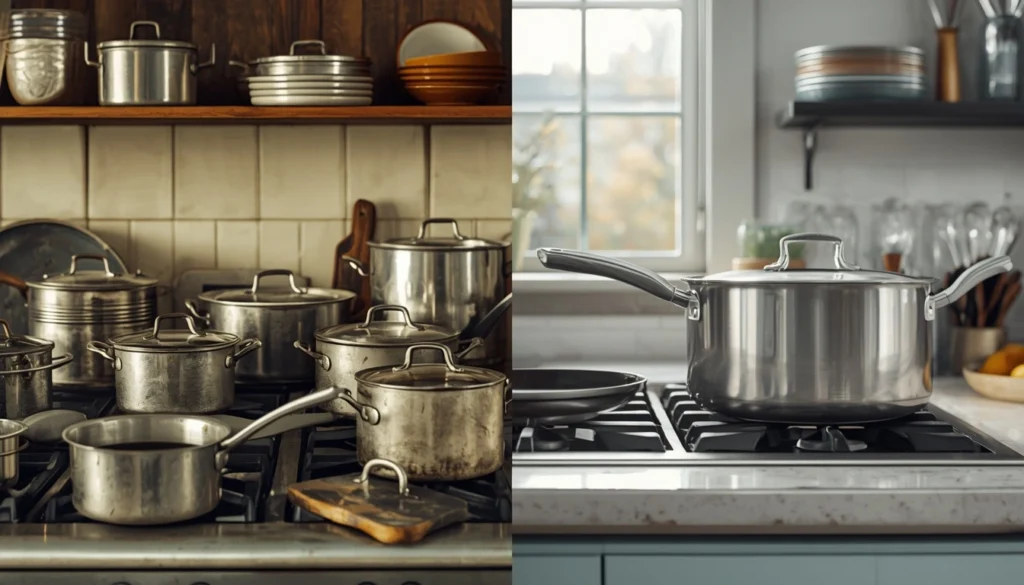
Aluminum’s decline wasn’t sudden. It was a slow slide driven by a mix of health concerns, better alternatives, and a shift in how Americans thought about cooking.
Aluminum Was Everywhere, Until It Wasn’t
For most of the 20th century, aluminum was the go-to material for everyday pots and pans. It was lightweight, heated up fast, and cost a fraction of copper. By the 1950s, it was in virtually every American kitchen.
The trouble started in the 1960s. Early studies began raising questions about aluminum’s relationship to brain disease. This caused the market to start shifting. According to CookDineHost, inventor John Ulam started experimenting with clad stainless steel cookware in the late 1960s. For reference Clad stainless steel cookware is stainless bonded over an aluminum core.
It was because he was frustrated with flimsy bare aluminum pans. By 1971, he was manufacturing them commercially, and the industry followed. DuPont’s Teflon nonstick coating, first used in cookware in 1961, also began dominating the market through the 1970s and 80s. They giving home cooks a low-maintenance alternative they loved.
In my early years of cooking aluminium was a go to material for me. I liked how fast it heated up what I was cooking. I turned away from it because of uneven heating. Every time i made a thick soup, it always seemed to burn at the bottom. The only way to avoid it was to ajust the flame and stir the soup every ten minutes while cooking. This drove me to stainless steel. It took longer to heat up the pan but it heated up more evenly. That meant less chances of my soup burning at the bottom.
The Leaching Problem
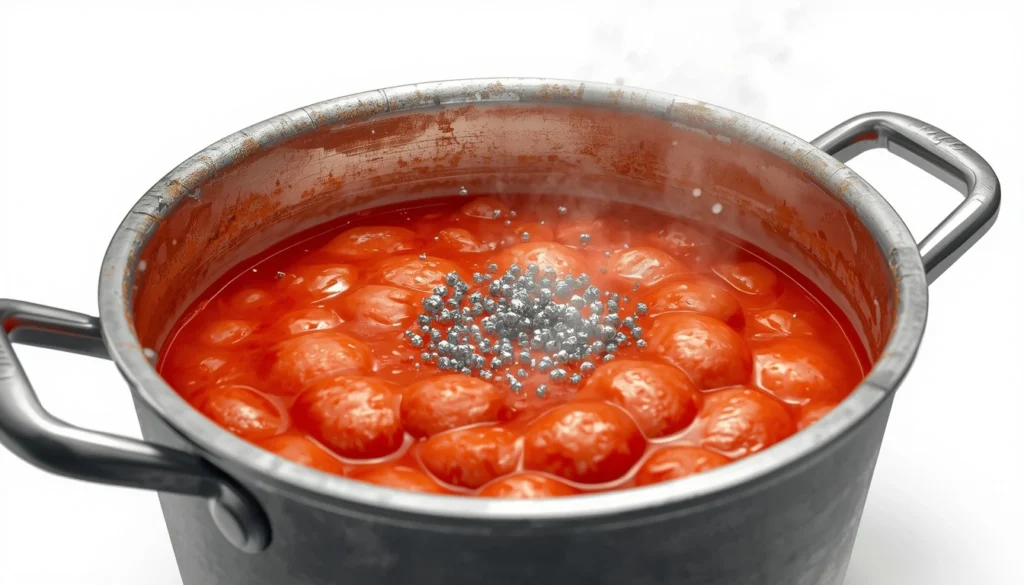
The bigger practical issue with uncoated aluminum is that it reacts with food. Especially acidic ingredients like tomatoes, citrus, vinegar, and wine. When you cook these foods in a bare aluminum pot, a small amount of the metal can transfer into your meal.
A landmark 2016 study published in Science of the Total Environment tested 42 aluminum cookware items from 10 developing countries. They found that uncoated aluminum pots could release up to 1,426 micrograms of lead per 250mL serving. This far exceeds WHO safety thresholds. That study focused on low-quality, scrap-metal cookware, which is an important distinction. But even standard aluminum pans show increased leaching when cooking acidic foods. The risk goes up significantly when pans are scratched, pitted, or worn.
According to a 2023 study published by the National Institutes of Health. Acidic food causes more metals to leach during cooking than neutral or alkaline foods. New aluminum cookware actually leaches more than older, well-seasoned pans. [Source: NCBI/NIH, 2023]
You can learn more about how different cookware materials behave in our guide to what materials are used in cookware.
How Stainless Steel and Nonstick Took Over
Stainless steel solved the reactivity problem that bare aluminum couldn’t. It doesn’t react with food, it’s durable, and it’s easy to clean. The 3-ply and 5-ply designs (stainless on the outside, aluminum or copper core inside) gave cooks the best of both worlds. You got heat conductivity of aluminum with the non-reactive surface of steel.
Nonstick pans solved a different problem: food sticking. For a generation of home cooks who wanted easy cleanup, Teflon was a revelation. By the 1980s and 90s, nonstick had become the default for everyday cooking.
[CALLOUT: Bare aluminum didn’t disappear, it got buried inside better pans. Most modern stainless steel cookware has an aluminum core for heat distribution. The key difference is that food never touches the aluminum directly.]
Is It Unhealthy to Cook with Aluminum Pots?
The straight answer: it depends on the condition of your pan and what you’re cooking. For most people using modern cookware in good condition, the risk is low. But it’s not zero.
What the Research Actually Says
Your body naturally processes small amounts of aluminum every day. It’s in food, water, and even some medications. The World Health Organization sets a Provisional Tolerable Weekly Intake (PTWI) of 2 mg per kilogram of body weight per week from all sources combined. The European Food Safety Authority (EFSA) puts it at 1 mg per kilogram of body weight per week.
Research published in the International Journal of Environmental Research and Public Health found this. The EU’s recommended migration limit for aluminum cookware is 5 mg per kilogram of food. For most people cooking in standard conditions. A well-maintained aluminum pan stays below that threshold. [Source: EFSA]
The real concern is cumulative exposure. Aluminum gets into your diet from many sources, cookware is just one of them. If you’re cooking acidic foods daily in scratched pans. Adding aluminum foil to the mix, and eating processed foods with aluminum-based additives, your total intake can creep up.
For a deeper look at aluminum, our article on is aluminum cookware safe breaks down the current science in detail.
When Aluminum Becomes a Bigger Risk
The risk increases in specific situations:
- Scratched or pitted pans: Damaged surfaces leach significantly more metal. If your pan has visible gray powder rubbing off or deep scratches, it’s time to replace it.
- Cooking acidic foods: Tomatoes, citrus juice, vinegar-based sauces, and wine all speed up leaching. These should not be cooked in uncoated aluminum for extended periods.
- Low-quality imports: A 2024 analysis found that 42% of tested global aluminum cookware items failed EU migration thresholds. Cheap imports from unregulated markets carry the highest risk. [Source: Bottega del Sarto, 2025]
- Children and infants: EFSA has noted that high-risk groups like infants and children on restricted diets may exceed safe aluminum intake limits more easily.
I get rid of pans for thsese reasons:
- When handle goes bad, because it can a safety hazard.
- If there is a hole that liquids can get through.
- When damage to the pan prevents it from sitting properly on stove or table.
- Depending on cookware material if it gets scratched badly.
What About the Alzheimer’s Link?
This is the claim that started the whole controversy. In the 1960s and 70s, researchers found elevated aluminum levels in the brain tissue of some Alzheimer’s patients. The theory that aluminum caused the disease spread fast.
Here’s where the science stands today: the link has not been proven. Alzheimer’s Research UK reviewed thousands of cases. They found no convincing evidence that normal dietary aluminum exposure causes Alzheimer’s disease. Most major health organizations, including the WHO and the Alzheimer’s Association, currently hold this position. [Source: NutritionFacts.org / Alzheimer’s Research UK review]
That said, the debate isn’t fully closed. Some researchers continue to investigate whether long-term, high-level exposure could be a contributing factor in people who are already genetically predisposed. The honest answer is: we don’t have definitive proof either way. The precautionary approach is to avoid cooking acidic foods in worn aluminum pans, not to throw out all your cookware.
Is Aluminum Cookware Banned in Europe?
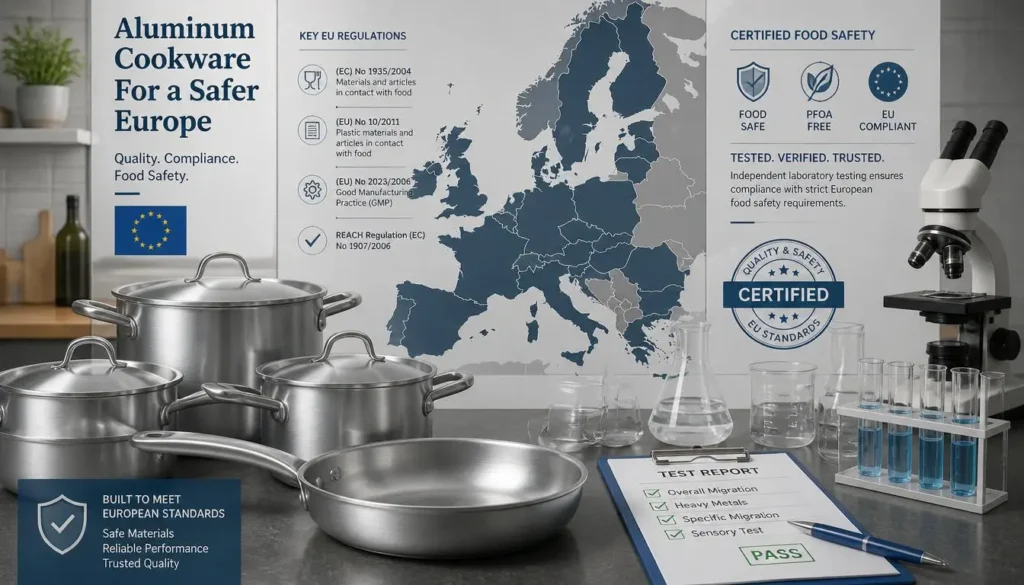
This is one of the most Googled questions about aluminum cookware, and the answer is frequently misreported online.
The Short Answer: No, But It Is Regulated
Aluminum cookware is not banned in Europe. There is no EU-wide ban. Aluminum pots, pans, and baking trays remain legal for sale and use in all European countries as of 2025. [Source: solamexhome.com, based on EU Regulation EC 1935/2004]
What the EU does is regulate how much aluminum can migrate from cookware into food. The Council of Europe recommends a migration limit of 5 mg of aluminum per kilogram of food. The EFSA sets a Tolerable Weekly Intake of 1 mg per kilogram of body weight from all sources. If cookware exceeds these limits, it cannot be sold in the EU market. [Source: EFSA / lecristalchinois.com, 2025]
Why the “Ban” Myth Spread
The confusion comes from a patchwork of national-level actions taken by individual European countries over the decades:
- Germany restricted aluminum cookware production in the 1980s. They cited possible links to Alzheimer’s disease.
- Italy banned aluminum bakeware and cooking utensils in the 1990s.
- France’s food safety agency (ANSES) issued a report in 2011 advising consumers against prolonged use of aluminum cookware. Particularly for acidic foods.
None of these actions constitute a full EU-wide ban. They reflect individual countries applying the precautionary principle more aggressively than others. When people say “Europe banned aluminum cookware”. They’re usually mixing up these country-specific restrictions with EU-wide policy.
What Europe Actually Requires
Under EU Regulation (EC) No 1935/2004. All materials that come into contact with food, including cookware, must be proven safe for their intended use. Manufacturers have to show that their products don’t transfer harmful substances into food above permitted levels.
The practical result: high-quality, properly manufactured aluminum cookware (including hard-anodized aluminum) continues to be sold across Europe. It’s the cheap, uncoated, poorly made products that tend to fail compliance testing and get pulled from shelves. [Source: EU Regulation EC 1935/2004]
Why Don’t We Use Copper Pots Anymore?
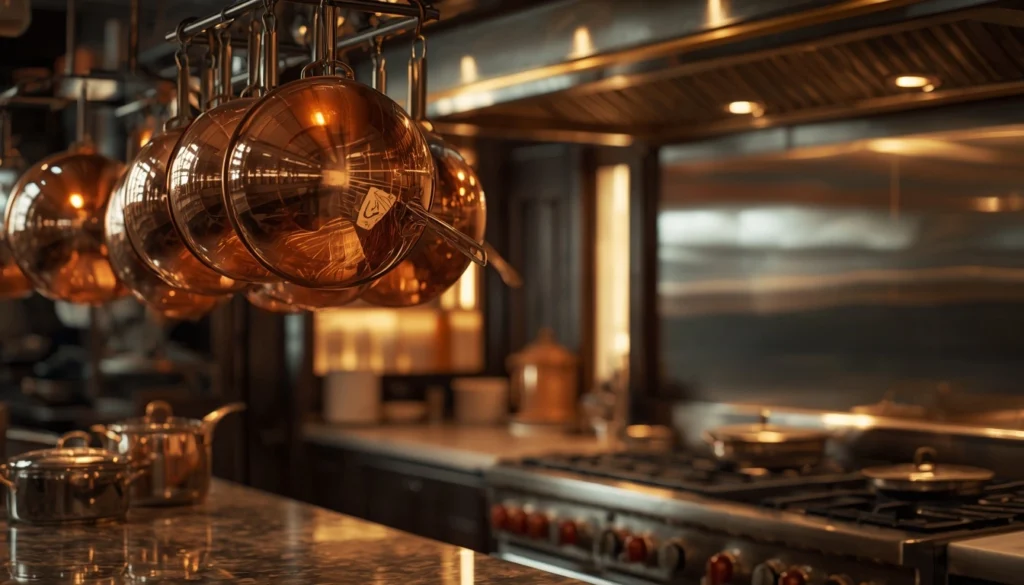
Copper didn’t disappear, but it did go from a kitchen staple to a niche item that most home cooks never touch. The story of why involves history, chemistry, money, and a major cultural shift in how Americans thought about cooking.
Copper’s Golden Age in the Kitchen
Copper has been used for cooking since at least 9000 BC. For professional cooks and serious home chefs, it was the undisputed best material for most of modern history. The reason is simple physics: copper conducts heat roughly 60% faster than aluminum and about 3,000% faster than stainless steel. [Source: ProWare Kitchen]
That superior conductivity means precise temperature control, fast response when you turn the heat up or down, and even heat distribution across the entire cooking surface. French professional kitchens still use copper pans for exactly this reason. If you’ve ever made a delicate hollandaise or a caramel sauce. You understand why even small temperature differences matter. Our article on copper cookware benefits covers this in more detail.
The Maintenance Problem That Killed Mass Appeal
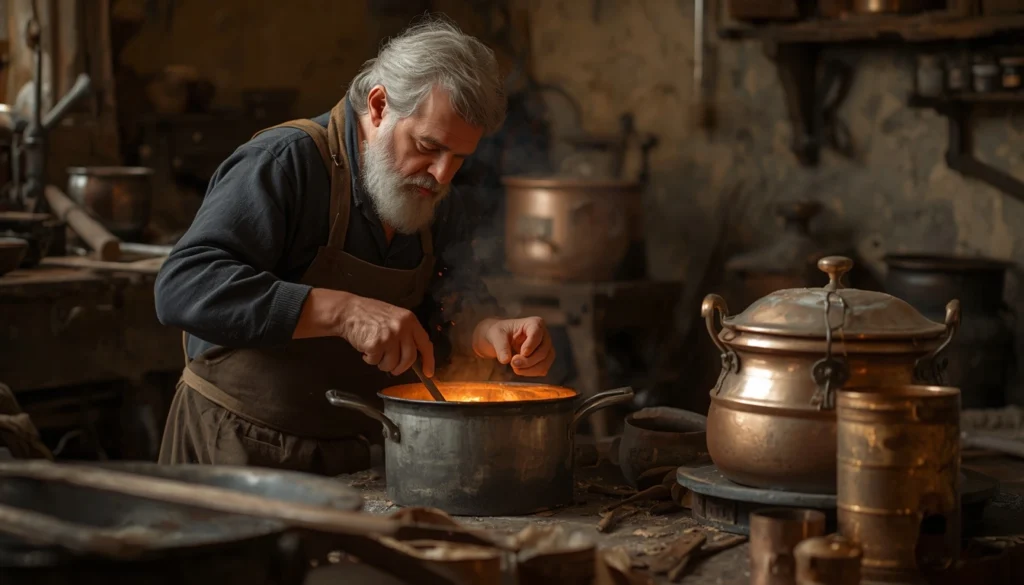
Here’s copper’s fatal flaw for the everyday home cook: you can’t cook directly in it. Raw copper reacts with acidic foods and leaches toxic levels of copper into your meal. The solution that developed over centuries was to line the inside of copper pots with tin. Tin is a soft, food-safe metal that acts as a barrier between the copper and your food.
The problem with tin linings is that they wear out. In the 18th and 19th centuries, it was common to send your copper pans out to be “re-tinned” every few years. This re-tinned was done by a craftsman called a tinker (yes, that’s where the word comes from). [Source: Daily Sabah / ProWare Kitchen]
By the mid-20th century, this practice was dying out. The craftsmen who could do the work were becoming rare. The process was expensive. And Americans in the 1960s and 70s were increasingly being told that cooking was drudgery to be avoided, not a craft to be invested in. Convenience foods and disposable cookware filled the gap.
According to Brooklyn Copper Cookware, the last US copper cookware manufacturer. The Waldow Company of Brooklyn, closed in 1979. Its wholesale business had been declining for years before that, as cheap nonstick pans took over the market. World War II also played a role. Copper was a strategic war material, and French copper cookware production came to a complete halt during the occupation. Some manufacturers switched to aluminum just to survive. [Source: vintagefrenchcopper.com]
The Health Risk of Unlined Copper
The health concern with copper is more clear-cut than with aluminum. Copper is an essential mineral, adults need about 0.9 mg per day. But the tolerable upper limit is 10 mg per day. Beyond that, copper becomes toxic. [Source: Biology Insights]
According to the National Institutes of Health. Chronic overexposure to copper can overwhelm the liver’s ability to process it. This leads to nausea, vomiting, stomach cramps, and in severe cases, liver damage and kidney disease. [Source: NIH / alva-cookware.us]
Unlined copper cookware is the main risk. When you cook acidic foods (tomatoes, citrus, wine-based sauces) in an unlined copper pan. The copper ions migrate into the food at levels that can cause real harm over time. Eating one meal cooked in an unlined pan won’t make you immediately sick, but regular use is a different story.
The good news, modern copper cookware is almost always lined with stainless steel. It doesn’t wear out and eliminates the leaching problem. Understanding the difference between lined and unlined copper is essential before you buy. Our article on lined vs. unlined copper cookware explains exactly what to look for.
Who Still Uses Copper and Why
Copper hasn’t gone away. Professional chefs, especially in French cooking traditions, still reach for copper when precision matters most. Sauces, sugar work, and egg-based dishes all enjoy copper’s instant heat response and even distribution.
For home cooks, modern copper pans lined with stainless steel offer real performance benefits without the safety or maintenance issues. They’re expensive, a quality copper pan can run $100 to $300 or more. They can last a lifetime and perform better than most alternatives for specific tasks. If you’re considering the investment, our guide on is copper cookware worth the investment walks through the honest pros and cons.
What Should You Use Instead?
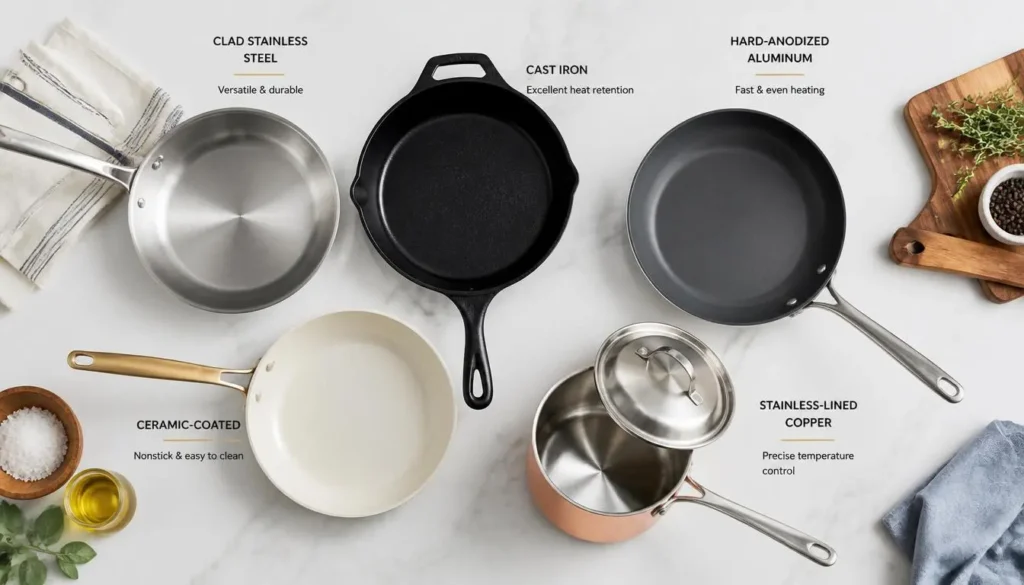
If you’re moving away from uncoated aluminum or old copper cookware, here are the most commonly recommended alternatives:
| Material | Best For | Key Advantage | Watch Out For |
|---|---|---|---|
| Stainless Steel (clad) | Everyday cooking, searing, sauces | Non-reactive, durable, dishwasher-safe | Poor heat distribution if single-ply |
| Hard-Anodized Aluminum | All-purpose cooking | Sealed surface, won’t leach, lighter than steel | Scratches can compromise coating |
| Cast Iron | High-heat searing, baking, slow cooking | Lasts generations, naturally nonstick when seasoned | Heavy, requires maintenance |
| Ceramic-Coated | Everyday cooking, eggs, low-fat cooking | Non-toxic coating, easy release | Coating wears over time |
| Lined Copper | Sauces, delicate dishes, professional use | Unmatched heat control | Expensive, heavy |
For a full breakdown of which metals are healthiest for everyday cooking, see our guide: Which Metal Is Healthiest for Cooking?
FAQs Why We Stop Using Aluminum & Copper Cookware
Is it safe to use old aluminum pots that have been in the family for years?
If they’re heavily scratched, pitted, or showing a grayish powder residue, it’s time to replace them. Older, undamaged pans with smooth surfaces are generally considered safe for non-acidic foods. Avoid cooking tomatoes, citrus-based dishes, or anything vinegar-heavy in them.
Does hard-anodized aluminum have the same risks as regular aluminum?
No. Hard-anodized aluminum goes through an electrochemical process that seals the surface. This surface is much harder and reduces the risk of metal leaching. It’s one of the better all-purpose cookware options available.
Can you still buy copper cookware with tin lining?
Yes, though it’s harder to find than stainless-lined copper. Tin-lined copper is traditional and beloved by purists for its slightly better heat transfer. But the tin does wear out and needs re-tinning. Stainless-lined copper is more practical for most home cooks.
Does cooking with copper give you extra copper in your diet?
Only if the pan is unlined or the lining is damaged. A properly lined copper pan with an intact stainless steel or tin interior does not transfer meaningful amounts of copper into food.
Are nonstick pans made from aluminum?
Most nonstick pans do have an aluminum base because of its light weight and heat conductivity. The key difference is that the nonstick coating covers the interior surface entirely. It’s so food doesn’t contact the aluminum directly. The safety of nonstick coatings is a separate question. PTFE (Teflon) and ceramic coatings each have their own considerations.
What cookware is safest for cooking acidic foods like tomato sauce?
Stainless steel, enameled cast iron, and ceramic-coated cookware are the safest options for acidic dishes. All three have non-reactive surfaces that won’t leach metals into acidic food.
Conclusion
Both aluminum and copper cookware declined for a combination of real and perceived reasons. Aluminum’s leaching issue is legitimate, especially with damaged pans and acidic foods. But the Alzheimer’s connection is still unproven. Properly maintained modern aluminum cookware is not the threat it’s often made out to be. The EU hasn’t banned it; they’ve simply put guardrails around it, which is a very different thing.
Copper’s decline had less to do with health and more to do with inconvenience. The maintenance requirements that were normal in the 18th century didn’t fit into the convenience-focused kitchen culture of the 20th. But modern lined copper pans solve that problem, and for certain types of cooking, nothing performs better.
The action items:
- Toss any aluminum pans that are scratched, pitted, or shedding gray residue.
- Avoid cooking acidic foods in uncoated aluminum or unlined copper.
- If you want copper’s performance benefits, look for stainless-lined options.
- When in doubt, clad stainless steel is the most versatile, safe, and durable everyday choice.
Your next step: check what’s actually in your current cookware collection and replace anything that doesn’t hold up. Our guide to what materials are used in cookware is a good place to start.