
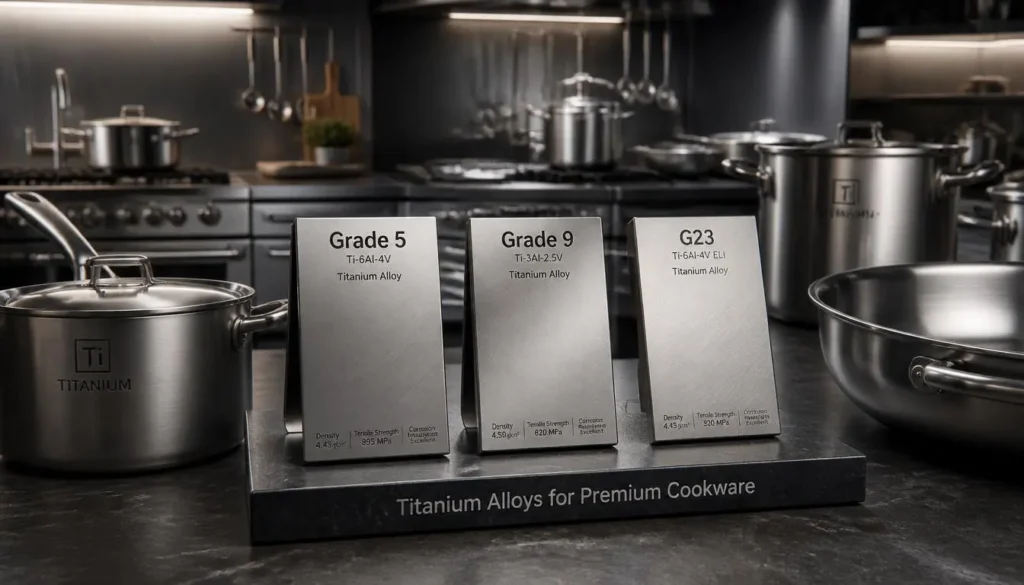
Key Takeaways
- Titanium grade numbers are not a quality ranking. A higher number does not mean better titanium. Each grade is designed for a specific job.
- Grade 1 and Grade 2 are the best choices for cookware because they are the purest, most food-safe forms of titanium with no added alloy metals.
- Grade 5 is the strongest titanium, but it contains aluminum and vanadium. This raises concerns for direct food contact at cooking temperatures.
- G23 and F136 are the same material, just two different ways to reference ASTM Grade 23, the medical implant standard. It is not used in cookware production.
- Most “titanium cookware” in stores is not solid titanium. It is usually aluminum with a titanium-reinforced nonstick coating. True solid titanium cookware is rare and expensive.
Introduction
There are more than 30 classified titanium grades, yet almost no cookware brand tells you which one their pan is made from. [More on this at: ASTM International, Titanium Grade Classifications]
That gap is a problem. If you are spending serious money on titanium cookware, or trying to figure out whether it is actually safe to cook on. The grade matters more than the marketing copy on the box.
Most people assume titanium is titanium. It is not. The difference between Grade 1 and Grade 5 titanium is like the difference between pure silver and a silver alloy. Same base metal, very different composition, very different behavior.
In this post, I will break down what each grade actually means. First I compare Grade 5 vs Grade 9 vs G23, then answer whether Grade 4 or Grade 5 is better. After I will tell you which grade you actually want in your kitchen.
What Are Titanium Grades and Why Do They Matter?
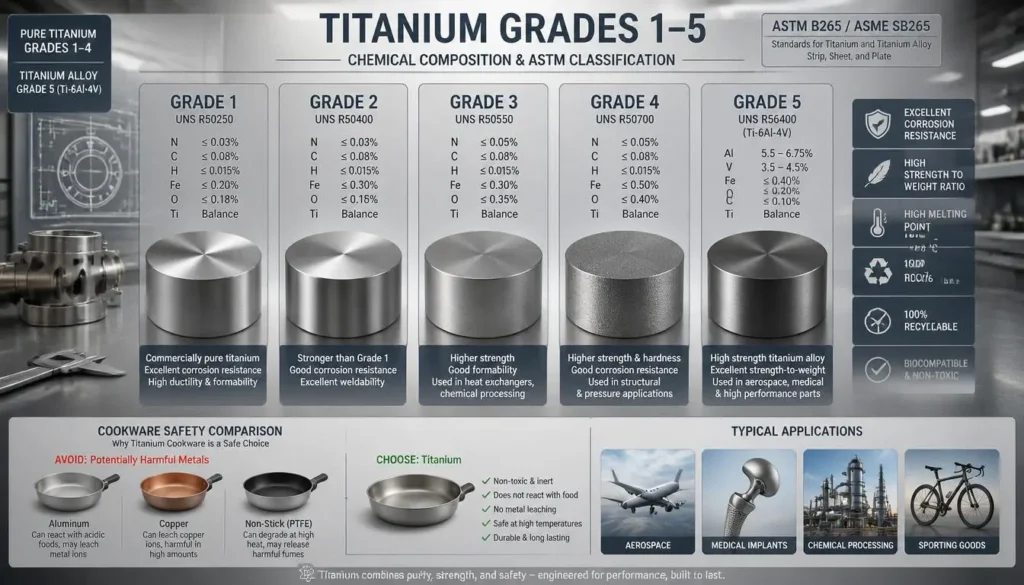
Titanium grades are standardized classifications set by ASTM International. ASTM groups titanium materials by their chemical composition, strength, and intended use. The grade tells you what is in the metal and what it was designed to do.
This matters for cookware because different grades contain different alloying elements. Some of those elements are not something you want leaching into your food.
Commercially Pure (CP) Titanium: Grades 1 Through 4
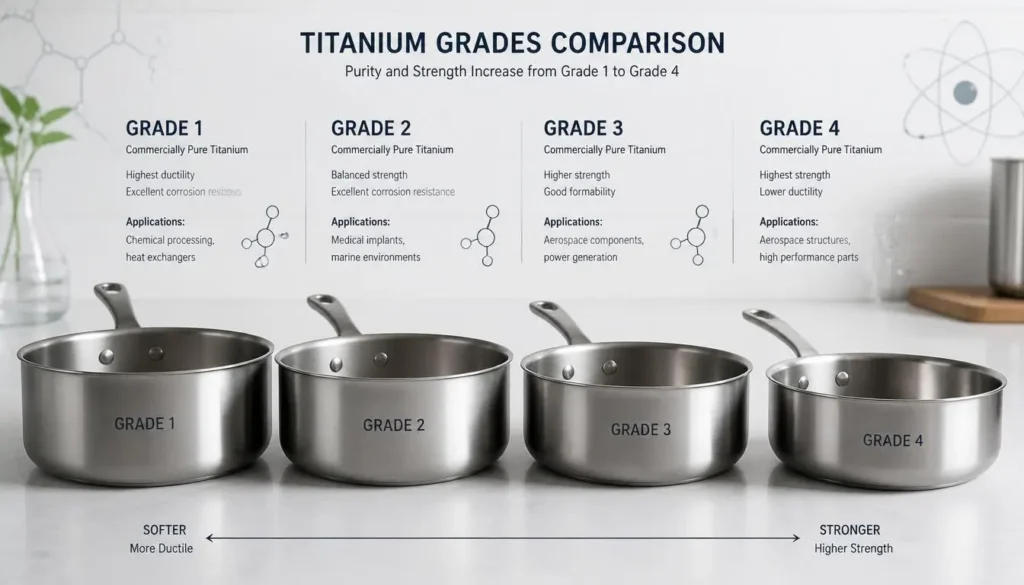
Grades 1 through 4 are called commercially pure (CP) titanium. They are all at least 99% pure titanium with very small amounts of oxygen, nitrogen, carbon and iron. There is no aluminum, no vanadium, nor added alloy metals.
Here is how they stack up:
- Grade 1: Softest, most ductile, highest corrosion resistance. Easiest to form into pans and sheets.
- Grade 2: Slightly stronger than Grade 1, still highly corrosion resistant. The most widely used CP grade across industries.
- Grade 3: More strength, less ductility. Less common.
- Grade 4: The strongest of the CP grades, but harder to work with. Used in some medical implants and industrial components.
As you go from Grade 1 to Grade 4, strength goes up and workability goes down. That is the trade-off within the CP family. [Read more at: International Titanium Association]
Titanium Alloys: Grades 5, 9, and 23
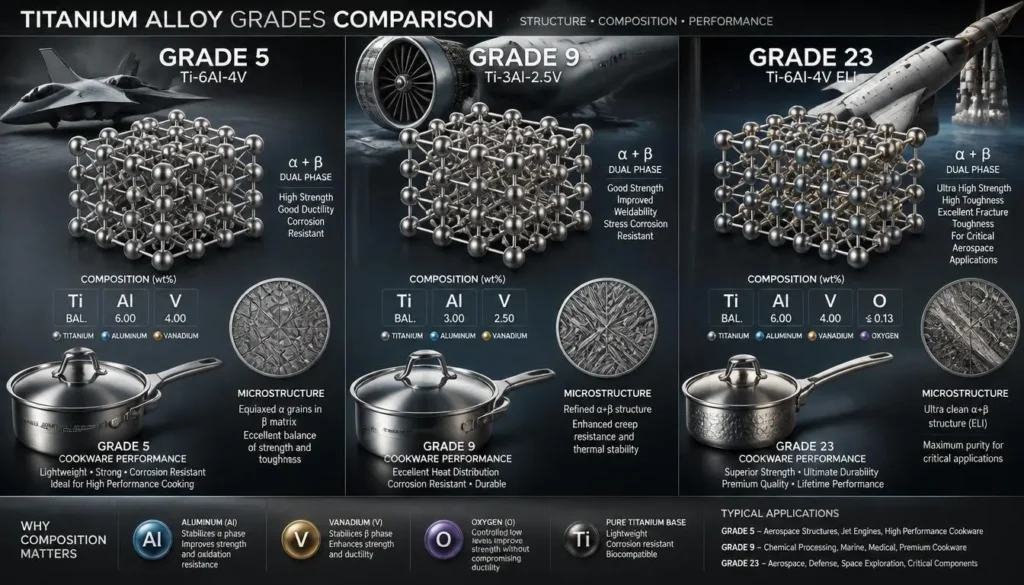
Grades 5, 9, and 23 are alloys, meaning other metals have been added to titanium on purpose to change its properties.
- Grade 5 (Ti-6Al-4V): 6% aluminum, 4% vanadium added. Much stronger than any CP grade.
- Grade 9 (Ti-3Al-2.5V): 3% aluminum, 2.5% vanadium. A middle ground between CP and Grade 5.
- Grade 23 (Ti-6Al-4V ELI): Same base as Grade 5 but with lower impurity levels for medical use.
The moment you add aluminum and vanadium to titanium, you gain strength but you introduce elements that were never meant to be in your food. [Learn more at: ASM International, “Titanium: A Technical Guide,” Matthew Donachie]
If you want to understand how titanium cookware fits into the broader category of what to cook with. Our guide to what is titanium cookware covers the full picture.
What Is the Highest Grade of Titanium?
The highest grade of titanium depends entirely on what you mean by “highest.” The ASTM grading system goes up to Grade 38, but that number is a classification label, not a score.
The Grading System Is Not a Ranking
This is the most important thing to understand about titanium grades. It is also something that most cookware marketing gets completely wrong.
Grade 38 is not better than Grade 1 any more than a hammer is better than a scalpel. They are different tools built for different jobs. [For more check out: ASTM International, Standards B265 and F136]
When someone asks “what is the highest grade of titanium,” they are usually asking the wrong question. The right question is: highest for what purpose?
What “Best” Actually Means by Application
| Application | Best Grade | Why |
|---|---|---|
| Aerospace structures | Grade 5 | Highest strength-to-weight ratio |
| Medical implants | Grade 23 (G23/F136) | Best biocompatibility, lowest impurities |
| Solid cookware | Grade 1 or Grade 2 | Purest, no alloy metals, food-safe |
| Industrial tubing | Grade 9 | Balance of strength and weldability |
| Chemical processing | Grade 2 | Corrosion resistance |
[Source: International Titanium Association, Application Guides]
For your kitchen, Grade 1 is the highest quality choice. It is the purest form of titanium with zero added alloy metals and the best corrosion resistance of any titanium grade.
What Is the Highest Quality Titanium?
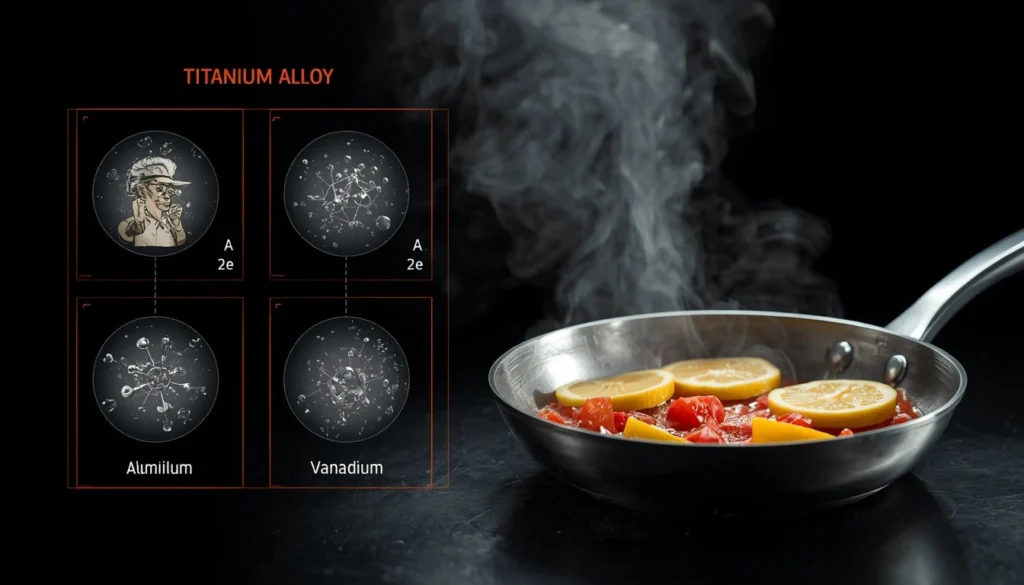
The highest quality titanium for cookware is Grade 1, which is over 99.5% pure titanium. For aerospace use, Grade 5 holds that title. For medical implants, it is Grade 23. Quality is always relative to the application.
Grade 5 Is the Strongest, But That Does Not Make It Best for Cooking
Grade 5 titanium (Ti-6Al-4V) has a tensile strength of around 130,000 psi, which is roughly four times stronger than Grade 1. That is impressive for plane frames, turbine blades, and structural parts.
The problem for cookware is the composition. Grade 5 contains 6% aluminum and 4% vanadium. At elevated cooking temperatures, trace amounts of these metals can potentially migrate into food. A 2021 review by the European Food Safety Authority (EFSA) on metal migration from cookware surfaces found this.
Alloy elements in metal cookware can transfer to food during cooking. Particularly with acidic ingredients like tomato sauce or citrus. [For mor check source: EFSA, Metal Migration in Cookware Review, 2021]
Vanadium in particular is a concern. It is an industrial metal, not a nutrient your body needs in meaningful quantities. Aluminum has its own ongoing debate in nutrition science. Neither belongs in your pasta sauce.
[Grade 5 titanium is the strongest, but it contains aluminum and vanadium. For cookware, you want Grade 1 or Grade 2, pure titanium with no added alloy metals and zero food-safety concerns.]
Grade 1 Is the Purest, and That Makes It Best for Food
Grade 1 is the most corrosion-resistant titanium grade available. It does not react with acids, salts, or most cooking chemicals. The FDA recognizes commercially pure titanium as safe for food contact applications. [Source: FDA CFR Title 21, Food Contact Materials]
Brands like Solidteknics use Grade 1 pure titanium, because of this purity profile. When a brand is willing to name the grade they use, that is a good sign. When they say “titanium” without any further detail, that should make you ask more questions. [Read more at: Solidteknics Technical Documentation]
You can learn more about what actually goes into safe titanium pans in our breakdown of is titanium cookware safe.
Is Grade 9 Titanium Better Than Grade 5?
Grade 9 titanium is not better than Grade 5 across the board. It depends on the application. Grade 9 is more weldable and formable. Grade 5 is stronger. For cookware, neither is the preferred choice.
Grade 9 vs Grade 5 Side by Side
| Property | Grade 9 (Ti-3Al-2.5V) | Grade 5 (Ti-6Al-4V) |
|---|---|---|
| Aluminum content | 3% | 6% |
| Vanadium content | 2.5% | 4% |
| Tensile strength | ~90,000 psi | ~130,000 psi |
| Ductility | Higher | Lower |
| Weldability | Easier | More difficult |
| Common uses | Bicycle frames, tubing, aerospace hydraulics | Aircraft structures, medical implants, motorsport |
| Cookware use | Not standard | Not standard |
[Source: International Titanium Association; ASM International]
Grade 9 is what you find in high-end bicycle frames and aerospace hydraulic tubing. It is popular because it offers a good balance between strength and the ability to be formed and welded without cracking. Grade 5 is used where maximum strength is non-negotiable, like jet engine components.
What This Means for Your Cookware Decision
Neither Grade 5 nor Grade 9 is the right material for a solid titanium pan. Both contain aluminum and vanadium. Both are harder to form into thin pan shapes compared to Grade 1 or Grade 2. And neither offers any food-safety advantage over the CP grades.
If a brand is marketing their pan as “Grade 5 titanium,” that is actually a red flag, not a selling point. It suggests the alloy content is higher than it needs to be for a cooking surface.
Is Grade 4 or Grade 5 Titanium Better?
For cookware, Grade 4 is better than Grade 5 because it is still commercially pure titanium with no added alloys. For high-strength industrial applications, Grade 5 wins. They are built for different purposes.
Grade 4 Is the Strongest Commercially Pure Titanium
Grade 4 sits at the top of the CP (commercially pure) family. It has tensile strength of around 80,000 psi. That is higher than Grade 1 (around 35,000 psi) while still containing no added aluminum or vanadium.
This makes Grade 4 a legitimate option for cookware applications where you want more durability without crossing into alloy territory. Some industrial and medical-grade components use Grade 4 for this reason. It provides the most strength without the alloy additions.
The trade-off is that Grade 4 is less ductile than Grades 1 and 2, which makes it harder and more expensive to form into complex cookware shapes. That is why most solid titanium cookware manufacturers default to Grade 1 or Grade 2 rather than Grade 4.
Grade 5 Is Stronger , But Adds Alloys
Grade 5 beats Grade 4 in raw tensile strength by a significant margin, around 130,000 psi versus 80,000 psi. But that strength comes from aluminum and vanadium, both of which have no business being in a cooking surface.
For cookware, Grade 4 wins over Grade 5 every time. It gives you more strength than Grade 1 or Grade 2 if you need it, without introducing metals that have raised food-safety questions.
To understand more about what makes titanium a smart (or sometimes overhyped) choice, see our in-depth look at is titanium cookware worth it.
Is G23 or F136 Titanium Better?
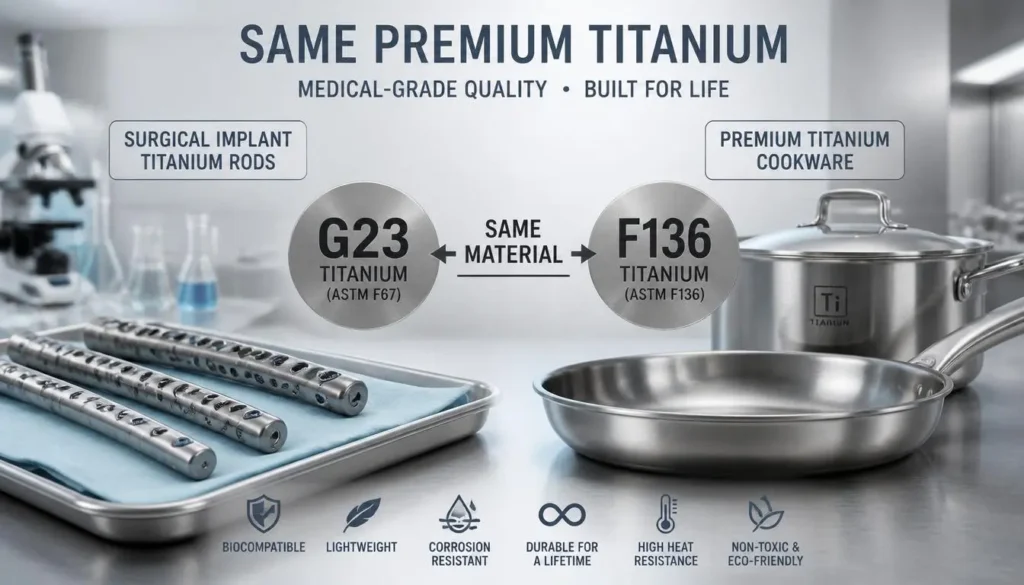
G23 and F136 are not two competing materials. They are two different names for the exact same thing. This is one of the most common points of confusion in titanium discussions. Especially in body jewelry and medical device communities where the terms get used interchangeably.
G23 and F136 Refer to the Same Grade
- G23 = shorthand for ASTM Grade 23
- F136 = the ASTM specification document number that defines the standard for that same material
Both refer to Ti-6Al-4V ELI, where ELI stands for Extra Low Interstitial. It is the same base composition as Grade 5 (6% aluminum, 4% vanadium) but with tighter controls on oxygen, nitrogen, and iron content. [Source: ASTM F136, Specification for Wrought Ti-6Al-4V ELI Alloy]
Asking whether G23 or F136 is better is like asking whether “Advil” or “ibuprofen” is stronger. Same compound, different label.
What ELI Means and Why It Matters
The “Extra Low Interstitial” designation means the levels of oxygen, nitrogen, carbon, and iron are kept even lower than standard Grade 5. This improves ductility and fracture toughness. Those two are critical when this material is used inside the human body as a hip replacement or bone screw. [Source: Journal of Biomedical Materials Research, biocompatibility studies on Ti-6Al-4V ELI]
This is a medical-grade material designed for surgical implants. The precision required to produce it makes it significantly more expensive than any CP grade.
Does G23 or F136 Belong in Your Kitchen?
Technically, neither G23 nor F136 is toxic for food contact. But the aluminum and vanadium are still present, and the cost is much higher than CP grades. Also there is no functional benefit for a cooking pan over Grade 1 or Grade 2.
If you see a brand claiming G23 or F136 titanium in their cookware, treat it as a marketing claim, not a quality advantage. The medical-grade designation sounds impressive. In the context of a frying pan, it is irrelevant.
Which Titanium Grade Is Actually Best for Cookware?
Grade 1 and Grade 2 commercially pure titanium are the best grades for cookware. They are non-reactive, FDA food-contact safe, and contain no alloy metals that could migrate into food.
The Case for Grade 1 and Grade 2
Grade 1 offers the highest corrosion resistance and the best formability. This makes it easier to manufacture into the thin, even shapes that good cookware requires. Grade 2 is slightly stronger while maintaining the same food-safety profile. Both are used by reputable solid titanium cookware brands.
The key advantage of both grades: they are inert at cooking temperatures. They do not react with acids, oils, or seasonings. They do not add any metallic taste to food. Ion migration studies on CP titanium show negligible transfer to food even with prolonged use. [Source: EFSA Metal Migration Review, 2021]
When You See “Titanium Cookware” at the Store
Here is the reality most brands do not advertise: the majority of cookware marketed as “titanium” does not contain solid titanium at all. It is aluminum or stainless steel with a titanium-reinforced nonstick coating. It is often PTFE with titanium particles embedded in it for scratch resistance.
That is not necessarily bad cookware. But it is not what the word “titanium” implies to most buyers. True solid titanium cookware, like the kind made from Grade 1 CP titanium, is rare, heavy to produce, and commands a much higher price point.
For a full comparison of how titanium stacks up against other popular materials, check out our guide to which metal is healthiest for cooking.
Quick Grade Reference for Cookware Buyers
| Grade | Composition | Tensile Strength | Food Safe? | Used in Cookware? |
|---|---|---|---|---|
| Grade 1 | 99.5%+ pure Ti | ~35,000 psi | Yes | Yes (best choice) |
| Grade 2 | 99%+ pure Ti | ~50,000 psi | Yes | Yes (common in solid Ti pans) |
| Grade 4 | 99%+ pure Ti | ~80,000 psi | Yes | Rarely (harder to form) |
| Grade 5 | Ti + 6% Al + 4% V | ~130,000 psi | Questionable | No (alloy concerns) |
| Grade 9 | Ti + 3% Al + 2.5% V | ~90,000 psi | Questionable | No |
| Grade 23 (G23/F136) | Ti + 6% Al + 4% V ELI | ~125,000 psi | Technically yes | No (medical grade, impractical) |
[Source: ASTM International; International Titanium Association; EFSA]
If you want to know more about the specific downsides of titanium cookware before you buy. Our article on titanium cookware disadvantages covers what most brands leave out.
FAQs About Titanium Grades Cookware
Is Grade 5 titanium food safe?
Grade 5 contains 6% aluminum and 4% vanadium, both of which can potentially migrate into food at cooking temperatures. It is not the recommended grade for cookware. Grade 1 and Grade 2 CP titanium are the food-safe choices.
What titanium grade is used in most cookware?
True solid titanium cookware typically uses Grade 1 or Grade 2 commercially pure titanium. Most products marketed as “titanium cookware” in regular stores use aluminum or steel pans with a titanium-reinforced nonstick coating, and do not specify a grade.
Is titanium cookware better than stainless steel?
Solid titanium cookware is lighter than stainless steel and completely non-reactive. However, it is much more expensive, harder to find, and does not conduct heat as evenly as multi-ply stainless steel. For most home cooks, the practical difference is small relative to the price gap.
Does titanium grade affect how long cookware lasts?
Yes, to a degree. Higher-purity grades like Grade 1 and Grade 2 are more corrosion resistant. It means they hold up better over time with normal kitchen use including acidic foods and regular washing. Alloy grades are stronger but that extra strength is not necessary for a pan.
Can titanium leach into food?
Commercially pure titanium grades (1 through 4) show negligible ion migration. This has been proven even with prolonged cooking, according to EFSA research. Alloy grades containing aluminum and vanadium carry a higher theoretical risk. This is why CP grades are preferred for food contact.
Conclusion
The titanium grade system is a classification tool, not a quality ladder. Grade 5 is not the best titanium. Grade 23 is not the safest. And G23 and F136 are not competing products. They are the same material with two names.
For cookware, the answer is straightforward: Grade 1 and Grade 2 commercially pure titanium are what you want. They are pure, non-reactive, food-safe, and the standard used by brands that are serious about what they put in their pans.
Before you buy anything marketed as titanium cookware, ask the brand one simple question: what grade of titanium is this? If they cannot answer, that tells you something.
For your next step, browse our detailed breakdown of the best titanium cookware brands. You will see which companies are actually transparent about the materials in their products.