
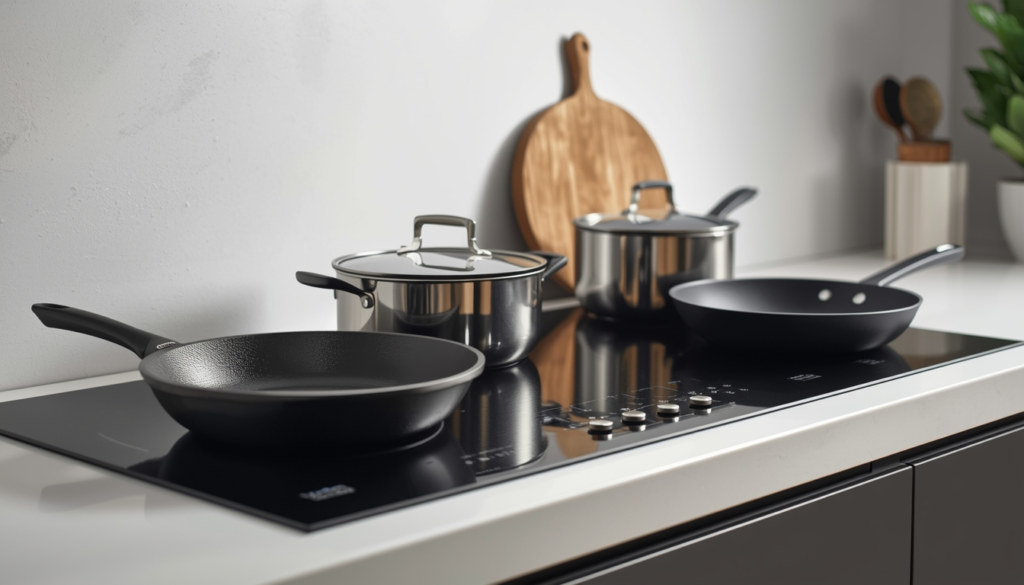
For best budget-friendly induction cookware options, you’ve come to the right place. I’ve done the research so you don’t have to waste money on cheap pans that warp after three uses. I’ll show how induction cooking works, the best affordable induction-compatible materials, and features that separate a great deal from a bad one.
Let’s get your kitchen equipped without draining your bank account.
Key Takeaways:
- Cast iron is the best budget induction cookware, magnetic, durable, and under $30
- Always run the magnet test before buying any pan for induction
- Look for a base thickness of at least 3mm to avoid warping and hot spots
- Budget sets work best when starting from scratch; individual pieces offer better control
- A hybrid strategy, budget stainless + one quality nonstick + cast iron, covers 90% of cooking needs
- Hand-washing extends the life of any budget cookware significantly
What Defines Budget-Friendly Induction Cookware?
Not all cheap cookware is value cookware. There’s a big difference.
Budget-friendly doesn’t mean the lowest price on the shelf. It means the best performance per dollar spent. Think of it as the cost-per-use model, a $25 pan that lasts two years is actually more expensive than a $60 pan that lasts ten years. This thinking applies whether you’re buying individual cookware pieces or entire cookware sets.
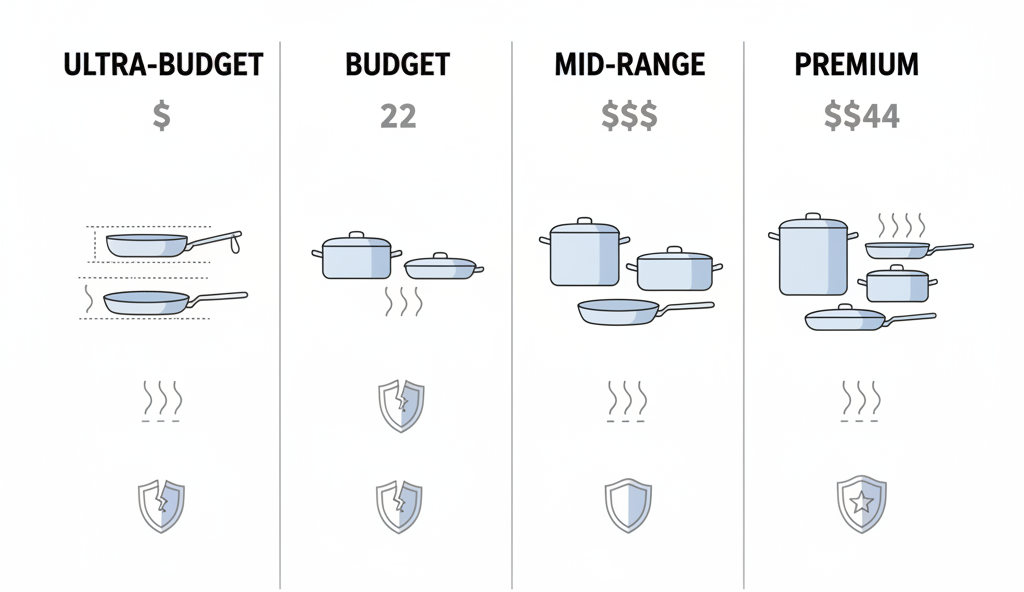
Price Ranges: What Counts as “Budget” in Induction Cookware
Here’s a general breakdown of what price tiers look like in the induction cookware market:
| Price Tier | Range | What to Expect |
|---|---|---|
| Ultra-Budget | Under $20/piece | Thin walls, may warp, short lifespan |
| Budget | $20–$50/piece | Decent durability, some compromises |
| Mid-Range | $50–$100/piece | Good performance, longer lifespan |
| Premium | $100+/piece | Professional-grade, built to last decades |
For most home cooks, the $20–$50 per piece range is the sweet spot for induction cookware on a budget.
Trade-Offs Between Cost, Durability, and Performance
Every budget purchase involves trade-offs. Here’s what you’re likely to sacrifice when you spend less:
- Thickness: Cheaper pans are often thinner, which causes hot spots and uneven cooking
- Coating quality: Budget nonstick coatings wear faster than pro cookware alternatives
- Handle durability: Riveted handles outlast welded ones on cheaper models
- Warranty coverage: Premium brands offer lifetime warranties; budget brands rarely do
Key Features You Should Never Compromise On
Even on a tight budget, walk away from any induction pan that lacks these:
- A flat, thick base (at least 3mm for even heating)
- A magnetic base (required for induction compatibility — more on this below)
- A heat-resistant handle (silicone or stainless steel preferred)
- Oven-safe rating of at least 350°F
- Dishwasher safe construction for easy everyday cleanup
Differences Between Cheap vs. Value-for-Money Cookware
Cheap cookware is made to hit a price point. Value cookware is made to solve a cooking problem efficiently. Brands like T-fal, Cuisinart, and Tramontina sit in the value-for-money category. They’re not luxury, but they’ve built solid reputations for affordable quality. Both in nonstick cookware sets and stainless steel cookware lines.
How Induction Compatibility Impacts Cost
Induction-compatible cookware must contain ferromagnetic material, usually iron or magnetic stainless steel. Adding this magnetic layer to aluminum pans increases manufacturing costs. That’s why a basic aluminum pan costs $10, but induction-ready cookware with a bonded magnetic base costs $30+.
How Induction Cooking Works (And Why It Affects Cookware Cost)
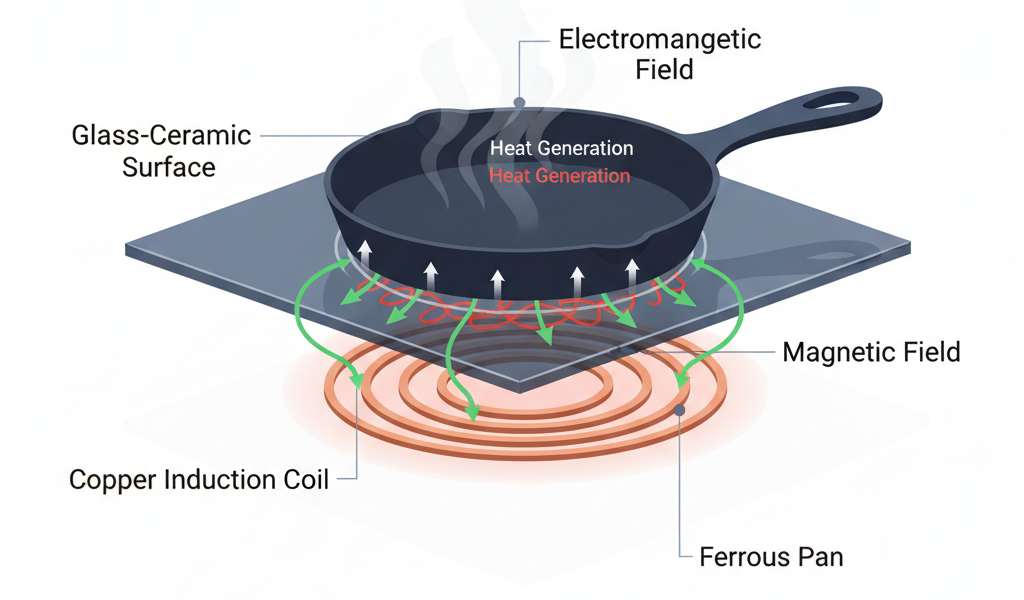
Understanding the technology helps you make smarter buying decisions. If you want a full breakdown, check out this detailed guide on how induction cooking works over at MyKitchenHints.
Basics of Electromagnetic Heating
Induction cooktops use electromagnetic induction. A process where an alternating electric current passes through a copper coil beneath the glass cooktop surface. This generates a magnetic field that creates heat directly inside the pan, not on the burner. The result is faster, more energy-efficient cooking than electric stoves or gas stoves.
Unlike radiant-electric stoves that use resistance heating and turn bright red. The flat induction cooktop surface stays relatively cool to the touch. This makes induction stovetops one of the safest cooking surfaces available in home kitchens today.
Why Magnetic Materials Are Required
The magnetic field only interacts with ferromagnetic metals, iron and certain types of steel. That’s why a simple aluminum or copper pot placed on an induction cooktop won’t heat at all. The induction-compatible cookware itself becomes the heat source, not the cooktop. If you use non-induction pans, the induction burner simply shuts off or flashes an error code.
Why Aluminum and Copper Need Added Layers
Aluminum heats evenly and quickly, which is why it’s popular in cookware. But it’s a non-induction-compatible material on its own. Manufacturers solve this by bonding a magnetic stainless steel disc to the bottom of aluminum pans. This adds cost but makes the pan induction-ready. The same approach applies to hard-anodized aluminum cookware.
Cost Impact of Multi-Layer Construction
More layers = better heating performance but higher price. Here’s how cookware construction affects pricing:
| Construction Type | Layers | Cost Impact |
|---|---|---|
| Single-ply stainless | 1 | Cheapest, uneven heat |
| Disk-bottom (encapsulated) | 2–3 | Moderate cost, decent performance |
| Tri-ply clad cookware | 3 | Mid-range, excellent heat distribution |
| 5-ply or 7-ply | 5–7 | Premium, restaurant-grade performance |
For budget shoppers, a disk-bottom or tri-ply cookware option gives the best value on an induction stove.
Common Misconceptions About Induction Cookware
Many people think their existing pots and pans won’t work on induction stoves. Some will — and the magnet test (explained later) tells you in seconds. Also, cast iron cookware works beautifully on induction stovetops without any modification. Because it’s already magnetic by nature.
Best Budget-Friendly Materials for Induction Cookware
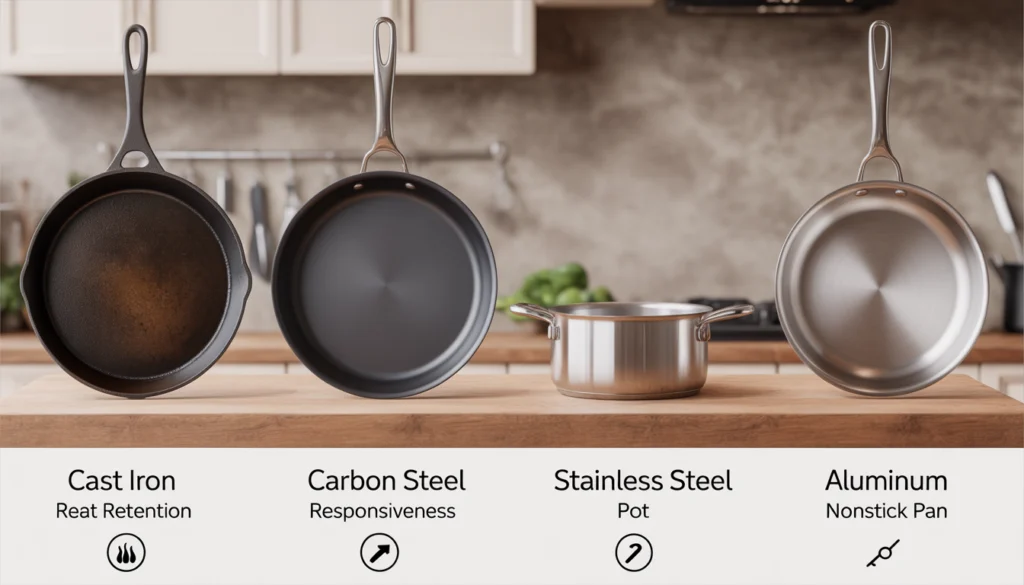
Material choice is the biggest factor in both price and performance when choosing induction-friendly cookware.
Stainless Steel (Affordable and Widely Available)
Magnetic stainless steel (grades 430 and 18/0) is natively induction-compatible and widely available at budget prices. Brands like Cuisinart and Tramontina offer stainless steel cookware sets in the $60–$150 range. Stainless steel cookware doesn’t react with food, is dishwasher safe, and lasts decades with proper care.
If you’re unsure if your existing stainless pans will work on an induction stove. This article on using stainless steel cookware on induction stoves covers exactly what to look for.
Best for: Searing, boiling, braising, and everyday cooking
Cast Iron (Low-Cost and Long-Lasting)
Cast iron cookware is arguably the best budget material for induction cooking. A basic 10-inch cast iron skillet from Lodge. A brand made in South Pittsburg, Tennessee, USA since 1896 costs around $20–$30 and will outlast your kitchen. Cast iron retains heat well, making it perfect for high-heat cooking like searing meats and baking cornbread.
For a deeper look at how this material performs on modern cooktops. Check out this complete guide to cooking with cast iron on an induction stove from MyKitchenHints.
Best for: Searing, frying, baking, slow cooking, one-pot meals
Case Study: A Lodge 10.25-inch cast iron skillet costs approximately $25. Used twice a week over 20 years, the cost-per-use drops to less than $0.02 per cook. No other cookware material matches this long-term value.
Carbon Steel (Budget Alternative to Cast Iron)
Carbon steel cookware is lighter than cast iron but shares many of the same properties. It’s used in professional kitchens across France and is growing in popularity in home kitchens across the US. Brands like Matfer Bourgeat and de Buyer make excellent carbon steel cookware, and budget-friendly options from BK Cookware. They also perform well on an induction range.
Best for: High-heat cooking, stir-frying, stir-fry dishes, omelets
Aluminum With Induction Base (Hybrid Budget Option)
Hard-anodized aluminum cookware with a bonded magnetic base gives you the even heating of aluminum at a budget price. T-fal and Gotham Steel use this construction in their affordable induction-compatible lines. These pans heat up fast and are often lighter than stainless steel or cast iron cookware.
Best for: Quick everyday cooking, eggs, sautéing vegetables, one-pan meals
Comparing Heat Retention, Responsiveness, and Price
| Material | Heat Retention | Responsiveness | Budget Range |
|---|---|---|---|
| Cast Iron | ⭐⭐⭐⭐⭐ | ⭐⭐ | $20–$50 |
| Carbon Steel | ⭐⭐⭐⭐ | ⭐⭐⭐⭐ | $30–$80 |
| Stainless Steel | ⭐⭐⭐ | ⭐⭐⭐ | $25–$100 |
| Aluminum (bonded) | ⭐⭐ | ⭐⭐⭐⭐⭐ | $20–$60 |
Which Materials to Avoid on a Tight Budget
Avoid pure copper and ceramic cookware sets in the budget range. Pure copper requires a bonded base to work on an induction cooktop and gets expensive fast. Budget ceramic nonstick cookware chips and loses its nonstick properties within a year in most cases. Glass cookware and titanium cookware are not induction-compatible without a bonded steel base.
Types of Budget Induction Cookware to Consider
Knowing what type of pan you need prevents over-spending on cookware pieces you’ll never use.
Frying Pans and Skillets
A 10-inch induction-compatible skillet is the single most versatile piece of cookware you can own. Look for a flat base, heat-resistant handle, and at least 2–3mm base thickness. T-fal E76597 and Lodge L8SK3 are rated top budget picks for induction-compatible skillets. A frying pan with an encapsulated base delivers even heat on a flat induction cooktop far better than single-layer options.
Saucepan Essentials
A 2-quart saucepan handles sauces, soups, oatmeal, and pasta water for everyday cooking. For induction cooking, look for a tight-fitting lid and a thick base to prevent scorching. Cuisinart MCP19-18N is a solid mid-budget pick around $35. An example of induction-ready cookware that performs well above its price point.
Stock Pots on a Budget
A 6–8 quart stock pot is essential for soups, stews, and boiling pasta. Budget-friendly stainless steel options from Amazon Basics and Farberware work well on an induction stove. But it’s when they include a magnetic base. Expect to spend $25–$50 for a decent induction-compatible pot in this size range.
Dutch Ovens for Induction
A durable dutch oven is one of the most versatile cooking vessels you can add to your kitchen. A 5-quart dutch oven or a 5.5-quart dutch oven handles braising, roasting, baking, and stovetop pressure cooking.
Cast iron dutch ovens from Lodge and enameled versions from budget-friendly brands like Crock-Pot both work well on induction stovetops. They double as oven-safe pieces, making them perfect for one-pot meals.
Woks and Specialty Pieces
An induction-compatible wok is harder to find at budget prices but worth tracking down if you love stir-frying or stir-fry dishes. Look for carbon steel woks with a flat base rather than a round bottom, the flat base is required for good contact with a flat induction cooktop. Joyce Chen and Yosukata both offer induction-compatible wok options under $60.
Multi-Piece Cookware Sets vs Individual Pieces
Sets offer lower cost-per-piece but often include pans you’ll never use. Individual pieces let you invest where it counts. Here’s a quick comparison:
| Buying Strategy | Pros | Cons |
|---|---|---|
| Full Set | Lower cost per piece, matching aesthetic | Includes unnecessary pieces |
| Individual Pieces | Buy exactly what you need | Higher unit cost |
| Starter Set (3–5 pcs) | Best balance of value and utility | Limited selection |
Space-Saving and Multipurpose Options
If you have compact kitchens or limited storage, look for stackable cookware or nesting sets designed for small spaces. Brands like GreenLife and Blue Diamond offer lightweight aluminum induction cookware sets that nest neatly. These are great options for tech-savvy cooks who want comprehensive cookware without the clutter.
Best Budget Induction Cookware Sets vs Individual Pieces
This is one of the most common dilemmas I hear from everyday cooks. For a broader look at this topic, here is a great deep-dive on budget-friendly cookware. It covers sets vs individual pieces across all cooking surface types.
When a Cookware Set Is More Cost-Effective
A cookware set makes sense when you’re starting from scratch and need everything at once. A 10-piece set from Tramontina (often found at Costco for under $150) offers top value compared to buying each piece individually. Featured cookware sets in this range also ensure uniform construction. This matters for consistent heating performance across pieces.
Downsides of Budget Cookware Sets
Many budget cookware sets include thin pans with inconsistent quality across pieces. A good budget set might have a solid skillet but a weak stock pot. Read reviews piece by piece, not just for the set . A versatile set should include at minimum a frying pan, saucepan, and stock pot, anything beyond that is a bonus.
Best Starter Pieces If Buying Individually
If I had to tell someone what to buy first, here’s my recommended priority order for induction-ready pieces:
- 10-inch skillet (most-used pan in any kitchen)
- 2-quart saucepan (essential for daily cooking)
- 12-inch skillet (for larger meals)
- 6-quart stock pot (soups, pasta, batch cooking)
- 5-quart dutch oven (braising, baking, one-pot meals)
Long-Term Value Comparison
| Option | Upfront Cost | Lifespan | Cost Per Year |
|---|---|---|---|
| Budget 10-piece set | $80–$150 | 3–5 years | $20–$50/yr |
| Mid-range individual pieces | $150–$250 | 8–12 years | $15–$30/yr |
| Premium individual pieces | $300–$500 | 20–30 years | $10–$25/yr |
Mixing Budget and Premium Cookware Strategically
The smartest kitchen strategy is a hybrid approach. Use budget stainless steel cookware for boiling and braising. Invest in a quality cast iron skillet and one good nonstick cookware pan. This gives you top cookware performance where it matters without overspending everywhere. It’s a similar approach to how professional kitchens mix workhorse pots with high-performance individual cookware pieces.
Key Features to Look for in Affordable Induction Cookware
Don’t get distracted by marketing. These are the features that actually matter when buying new cookware for an induction stove.
Magnetic Base Strength and Compatibility Test
Run the magnet test before buying. Hold a fridge magnet to the bottom of the pan. If it sticks firmly, the pan will work on an induction cooktop. A weak stick means a weak magnetic base, which equals slow or uneven heating on any induction burner.
Even Heat Distribution on a Budget
Look for encapsulated bases or full-clad construction even in budget cookware. A thick aluminum core sandwiched between stainless steel layers (tri-ply clad cookware) distributes heat more evenly than single-layer options. Tramontina’s tri-ply line offers this at budget prices. It is one of the best examples of affordable induction-compatible pieces with pro cookware performance.
Handle Design and Heat Resistance
Riveted handles are stronger than welded ones. Look for handles with a stay-cool design — either hollow stainless steel or silicone-wrapped. Avoid handles made entirely of thin metal that will heat up during stovetop cooking and cause burns.
Lid Quality (Glass vs Metal)
Tempered glass lids let you check food without lifting the lid and losing heat. Stainless steel lids are more durable and oven-safe at higher temperatures. For budget induction cooking, glass lids are usually fine unless you’re doing high-heat cooking with oven finishing above 450°F.
Oven and Dishwasher Safety
Many budget pans are oven-safe up to 350–400°F, which covers most everyday cooking needs. If you do a lot of oven finishing, like searing then roasting. Look for pans rated to at least 500°F. Dishwasher safe pans save time, but hand-washing extends the life of any budget cookware set.
Weight and Thickness Considerations
A good induction pan should feel a little heavy but not exhausting to lift. Aim for a base thickness of at least 3mm for frying pans and 2.5mm for saucepans. Lightweight pans that feel hollow often have thin walls that warp under high-heat cooking situations.
Common Problems With Cheap Induction Cookware (And How to Avoid Them)
Knowing the failure modes helps you avoid them or spot a bad product. Good to know before you buy new induction cooktop that becomes a frustrating experience.
Warping and Uneven Heating
Warping happens when a thin pan heats unevenly and the metal expands at different rates. On induction cooktops, a warped base creates gaps that reduce heating ability and cooking efficiency. The fix: buy pans with a minimum 3mm base thickness and avoid preheating on maximum temperature settings.
Weak Magnetic Base Issues
Some budget pans use a thin magnetic disc glued or spot-welded to the bottom. These can delaminate over time, especially with thermal cycling (repeated heating and cooling). Look for pans that state the magnetic layer is fully bonded or encapsulated in the base. This is what separates real induction-compatible cookware from marketing fluff.
Hot Spots and Burning Food
Hot spots occur when heat doesn’t spread evenly across the cooking surface. This is common in single-ply stainless steel budget pans and non-induction pans used with adapter discs. Using gentler heat settings instead of blasting on high reduces this problem and extends the life of your pan.
Poor Durability and Coating Wear
There are budget nonstick cookware especially PTFE coatings at low price points. These wear faster than premium versions. Signs of wear include flaking, peeling, or food starting to stick where it didn’t before. Once the coating is compromised, replace the pan.
This is one area where non-toxic cookware sets using ceramic coatings have an advantage. Even when the coating wears, it’s safer than degraded PTFE.
Noisy or Vibrating Cookware on Induction
Some induction cooktops and induction stoves cause cookware to hum or vibrate. It’s due to the frequency of the electromagnetic field. This is more common with lightweight pans and thin bases. Heavier pans with fully bonded bases, like cast iron cookware or tri-ply clad cookware, are far less prone to this issue.
How to Spot Low-Quality Products Before Buying
Watch for these red flags when shopping for new cookware:
- No stated base thickness in the product description
- Vague “induction-safe” labels without specifics
- Extremely lightweight for its size
- No country of manufacture listed
- Reviews mentioning warping within 6 months of use
How to Find the Best Deals on Induction Cookware
Price and value aren’t the same thing, but getting both is very possible with smart shopping for induction-ready cookware.
Best Times of Year to Buy Cookware
The best deals on cookware sets and individual pieces happen at predictable times:
- Black Friday / Cyber Monday (November): Deepest discounts of the year
- Amazon Prime Day (July): Major induction cookware and kitchen appliances deals
- January sales: Holiday inventory clearance
- Wedding season (April–June): Retailers push cookware promotions heavily
Online vs In-Store Price Differences
Online retailers like Amazon, Walmart.com, and Target.com offer 15–30% lower prices than brick-and-mortar stores on the same cookware. But, in-store purchases let you feel the weight and quality before buying. It matters a lot for budget cookware pieces where construction quality varies widely.
Refurbished or Open-Box Cookware Options
Open-box cookware from stores like Best Buy or warehouse clubs is often 30–50% off retail with minimal wear. Since pots and pans don’t have complex electronics, open-box is generally a safe buy. Look for unboxed items with no scratches on the cooking surface or base.
Discount Brands vs Premium Brands on Sale
A mid-range brand on sale usually beats a budget brand at full price. All-Clad cookware has factory seconds sales where tri-ply clad cookware sells for 40–60% off. These are far better than new budget pans at the same price. A real upgrade in cookware construction and heating performance.
Coupon Stacking and Bundle Deals
Use browser extensions like Honey or Capital One Shopping to find promo codes automatically. Stacking a sale price with a store coupon is one of the most effective ways to get right cookware at the right price. Especially when buying a full-size cookware set or a featured cookware set that includes many pieces.
Are Nonstick Budget Induction Cookware Options Worth It?
Nonstick cookware is the most searched cookware category. But budget nonstick cookware sets have some important caveats worth understanding before you buy.
Pros and Cons of Budget Nonstick Cookware
Pros:
- Easy food release (great for eggs, fish, delicate foods)
- Easy cleanup
- Lower cooking oil requirements
- Lightweight and easy to handle for everyday cooks
Cons:
- Shorter lifespan than stainless or cast iron cookware
- Scratches easily, even an affordable pan needs careful handling
- Most budget nonstick coatings degrade within 2–3 years
- Some cheaper coatings raise health concerns at high temperatures
Longevity Concerns With Cheap Coatings
Budget PTFE (Teflon) coatings are thinner and less durable than those in higher-end nonstick cookware sets. Brands like GreenPan introduced ceramic nonstick cookware coatings (free of PFOA and PTFE) as a safer alternative. Though budget ceramic cookware also wears faster than premium versions.
Safer Nonstick Alternatives
Look for cookware labeled PFOA-free and PFAS-free for peace of mind. Some non-toxic cookware sets use ceramic coatings, enameled cast iron cookware and seasoned carbon steel cookware. All offer nonstick-like cooking surfaces without synthetic coatings. These are better long-term choices for health-conscious home cooks.
When to Choose Stainless Steel Instead
If you cook at high heat, deglaze pans often for a pan sauce, or want cookware that lasts decades. Stainless steel cookware is the smarter budget investment. It doesn’t have a coating to wear out, works on all cooking surfaces, and handles stovetop cooking to oven use to dishwasher cleaning.
Maintenance Tips to Extend Lifespan
- Use wooden or silicone utensils only, metal scratches nonstick coatings
- Never heat an empty warm pan on an induction burner
- Hand wash with mild dish soap and a soft sponge to keep pan clean
- Store with pan racks or felt protectors between stacked pieces
- Replace when you see any flaking or peeling
Best Budget Induction Cookware Brands to Consider
These brands consistently appear at the top of value-for-money ratings for induction-compatible cookware. For more on whether it’s worth spending more, check out this luxury and high-end cookware to understand what you’d be upgrading to.
Reliable Low-Cost Cookware Brands
| Brand | Country | Known For | Price Range |
|---|---|---|---|
| T-fal | France (owned by SEB Group) | Nonstick, lightweight | $20–$80/set |
| Tramontina | Brazil | Stainless tri-ply, cast iron | $30–$150/set |
| Lodge | USA (Tennessee) | Cast iron, carbon steel | $15–$60/piece |
| Cuisinart | USA | Stainless steel, variety | $40–$200/set |
| GreenLife | Belgium | Ceramic nonstick | $25–$100/set |
Store Brands vs Name Brands
Amazon Basics and Kirkland (Costco) offer surprisingly decent quality at rock-bottom prices. The tradeoff is limited warranty support and harder-to-find replacement lids. Name brands have better customer service, established quality controls, and better resale value. For similar cookware at different price points. Comparable stainless steel construction often means dramatically different base thickness.
What Makes a Budget Brand Trustworthy
A trustworthy budget brand will:
- Clearly state base thickness and material composition
- Offer at least a 1-year warranty on their cookware line
- Have verifiable product reviews (not just generic 5-star clusters)
- Be sold through established retailers (not just third-party Amazon sellers)
- Provide clear induction compatibility labeling on packaging
Red Flags When Evaluating Unknown Brands
- No brand website or contact information
- Copycat product photos of well-known cookware brands
- Suspiciously low prices ($5 for a “tri-ply” pan)
- No country of manufacture disclosed
- Returns policy buried or absent
- Claiming “non-toxic cookware” without stating what coating is actually used
Entry-Level Lines From Premium Brands
Some premium cookware brands offer entry-level product lines that give you their quality control at reduced prices:
- All-Clad HA1 line — hard-anodized aluminum cookware, significantly cheaper than their stainless lines but still induction-ready
- Le Creuset Toughened Nonstick — lower-cost than their signature enameled cast iron cookware
- Calphalon Classic — entry-level from a brand known for pro cookware in professional kitchens
How to Test If Cookware Works on Induction (Before Buying or Using)
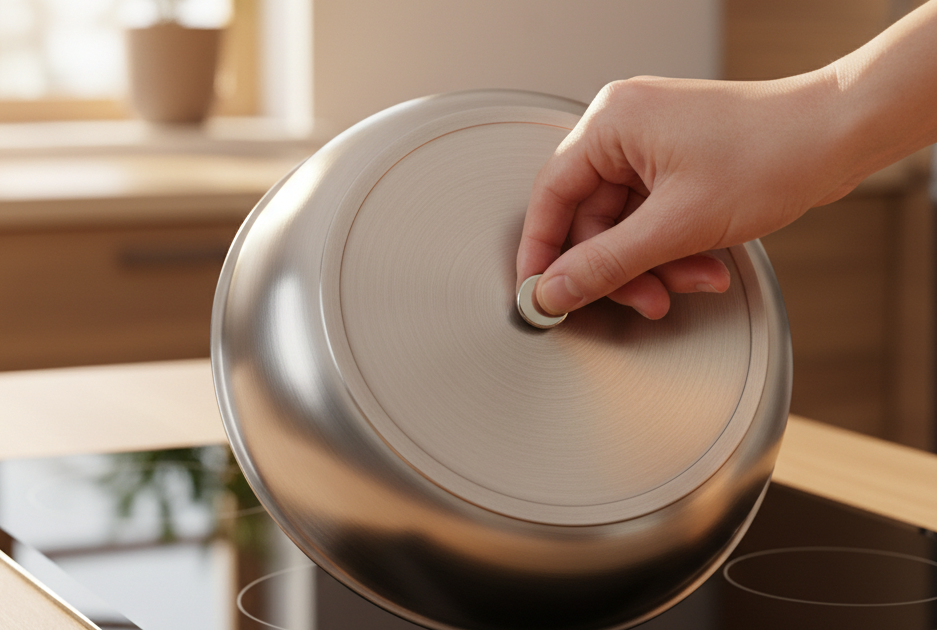
This is one of the most common practical questions from home cooks who just got a new induction stove. For a comprehensive look at the science behind it, this article on how to tell if your cookware is induction compatible is an excellent resource.
The Magnet Test Explained
Grab any refrigerator magnet and hold it against the bottom of the pan. If the magnet sticks firmly and doesn’t slide off, the pan is induction-compatible. If the magnet doesn’t stick at all, those non-induction pans won’t work on your cooktop.
A weak or partial stick may work on induction cooktops, but heating will be slower and less efficient. This often indicates a thin or partial magnetic disc rather than a fully bonded base, a red flag in any budget induction-ready cookware.
Label Indicators to Look For
Most modern induction-compatible cookware will show one of these on the packaging or base:
- The induction symbol (a coil icon, often written as )))) or ≋)
- The phrase “induction compatible” or “induction ready”
- A label listing compatible cooking surfaces including “induction”
- The phrase “for all stove types” including induction stoves and electric ranges
Testing Cookware at Home Safely
If you already own cookware and want to test it before using it on your new induction cooktop, use the magnet test first. Once the magnet sticks, place the pan on the cooktop, turn it on to medium, and add a tablespoon of water. If it heats within 30–60 seconds, the pan is cookware ready for safe use.
What to Do if Cookware Doesn’t Work
If your favorite pan isn’t induction-compatible, you have two options:
- Buy an induction adapter disc — a flat magnetic plate that sits between the pan and the induction burner. Brands like Ilsa and Mauviel make these. They work but reduce rapid heating efficiency.
- Replace the pan — often more cost-effective long-term, especially for budget cookware that’s already a few years old.
Care and Maintenance Tips to Make Budget Cookware Last Longer
Proper care is the best way to get more value from budget induction cookware and to avoid buying new cookware pieces more often than necessary.
Proper Cleaning Techniques for Different Materials
| Material | Cleaning Method |
|---|---|
| Cast Iron | No soap (or mild soap), dry immediately, re-season occasionally |
| Carbon Steel | Same as cast iron |
| Stainless Steel | Dish soap fine, Bar Keepers Friend for stuck-on food |
| Nonstick | Mild soap, soft cloth only, never abrasive pads |
| Enameled Cast Iron | Dish soap ok, avoid metal scourers |
| Ceramic Nonstick | Gentle hand-wash only, avoid sudden temperature changes |
To keep a pan clean and performing at its best, always let it cool before washing — sudden cold water on a warm pan can warp even mid-range cookware.
Avoiding Warping and Overheating
- Never place a cold pan on maximum temperature. Always start at medium with careful temperature control and increase gradually
- Avoid thermal shock: don’t run a hot pan under cold water after stovetop cooking
- Don’t leave empty pans on an active induction burner at any heat setting
- Always use safe temperature settings appropriate for the cooking situation
Storage Tips to Prevent Damage
- Use felt pan protectors or paper towels between stacked pans
- Hang pans on pan racks if space allows, this prevents stacking damage entirely
- Store cast iron and carbon steel cookware in a dry location to prevent rust
- Keep bakeware separate from stovetop pans to avoid scratching induction-compatible pieces
How to Restore Performance Over Time
- Stainless steel: Use Bar Keepers Friend (a product from Bar Keepers Friend Company, Nashville, Tennessee) to remove discoloration and restore shine
- Cast iron: Re-season by rubbing with vegetable oil and baking upside-down at 450°F for one hour
- Carbon steel cookware: Same seasoning process as cast iron — builds a natural nonstick surface over time
- Nonstick: Unfortunately, worn nonstick coatings cannot be restored. Replacement is the only solution
When to Replace Budget Cookware
Replace budget cookware when you notice:
- Warped base that rocks on a flat induction cooktop surface
- Flaking or peeling nonstick or ceramic coating
- Rust that won’t come out after re-seasoning (cast iron)
- Loose or wobbly handles — a safety hazard on any stove
- Significant uneven cooking or hot spots that affect results
Budget vs Premium Induction Cookware: Is It Worth Upgrading?
At some point, every home cook asks this question. Especially after investing in a new induction cooktop or portable induction cooktops.
Performance Differences in Real Cooking Scenarios
All-Clad heats more evenly, retains heat better, and responds more precisely to temperature controls. For professional results, restaurant-quality sears, precise sauce reductions, this matters. For everyday cooking and weeknight meals. Budget induction-compatible cookware performs adequately across most recipes.
Durability Comparison Over Time
| Cookware Type | Expected Lifespan |
|---|---|
| Ultra-budget | 1–3 years |
| Budget | 3–7 years |
| Mid-range | 7–15 years |
| Premium (All-Clad, Le Creuset) | 25–50+ years |
Cost-Per-Use Analysis
A $200 All-Clad skillet used daily for 25 years costs about $0.02 per use. A $25 budget skillet replaced every 3 years at the same frequency costs about $0.023 per use. The difference is small, but the premium pan delivers a better cooking experience throughout. A former chef or experienced cook will feel this difference far more than an occasional home cook.
Who Should Upgrade (And Who Shouldn’t)
Consider upgrading if you:
- Cook daily and notice performance limitations with your current pans
- Care deeply about even searing and careful temperature control
- Want to stop buying new cookware pieces every few years
Stick with budget if you:
- Cook occasionally (less than 3x per week)
- Are a beginner home cook still learning techniques
- Are outfitting a temporary living space or compact kitchen
Hybrid Approach: Combining Budget and Premium Pieces
My personal recommendation: invest premium in one or two key pieces, and stay budget everywhere else. A Lodge cast iron skillet ($25) + a good stainless saucepan ($40) + a quality nonstick frying pan ($50–$80) covers 90% of cooking needs for under $150 total. This is the smart setup most cookbook authors and recipe developers actually use at home.
Frequently Asked Questions About Budget Induction Cookware
What Is the Cheapest Cookware That Works on Induction?
Cast iron cookware is the cheapest fully induction-compatible option. A basic Lodge cast iron skillet costs around $20–$30 and works perfectly on induction cooktops without any modification. It’s magnetic by nature and built to last for generations, a true budget-friendly set cornerstone.
Can You Use Regular Pans on Induction With Adapters?
Yes, induction adapter discs allow non-induction pans to work on induction cooktops. They typically cost $15–$40 and act as a go-between for the cooktop and your pan. But, they reduce energy-efficient cooking performance and rapid heating speed. So they’re best used as a temporary or occasional solution while you transition to proper induction-compatible cookware.
Is Cast Iron the Best Budget Option?
For heat retention and longevity, yes, cast iron cookware is the best budget option for induction cooking. It’s magnetic, virtually indestructible, improves with age, and costs under $30 for excellent quality. The only downsides are weight and the need for occasional re-seasoning. For everyday cooks who want a durable dutch oven or skillet that lasts a lifetime, cast iron is unbeatable.
Why Does Some Cookware Not Work on Induction?
Cookware that doesn’t work on induction stoves is made from non-ferromagnetic materials. Primarily aluminum, copper, or non-magnetic stainless steel (grades 18/10 and 304). These non-induction-compatible materials don’t respond to electromagnetic fields. Thus don’t heat on induction cooktops or induction burners.
How Long Should Budget Cookware Last?
With proper care, budget induction cookware should last 3–7 years. Cast iron and carbon steel cookware are exceptions — they can last 20–50+ years if properly seasoned and maintained. Nonstick cookware sets in the budget range have the shortest lifespan at 2–4 years. Especially with heavy daily use on high-heat settings.
Are Portable Induction Cooktops Different From Built-In Induction Ranges?
Portable induction cooktops use the same electromagnetic technology as full built-in induction ranges and induction stovetops. The cookware requirements are identical. You still need induction-compatible cookware with a magnetic base.
Portable induction cooktops are great for small apartments, extra cooking zones, or travel cooking. All the budget induction-ready pieces recommended in this guide will work on them.
Final Thoughts: Getting the Most From Your Budget
You don’t need to spend a fortune to cook well on an induction stove. The key is knowing what matters, magnetic base quality, base thickness, handle durability and not getting distracted by flashy marketing. Start with a Lodge cast iron skillet, add a budget stainless saucepan, and build from there as your cooking needs and budget grow. Smart buying beats big spending every single time.
Want to keep learning about getting the most out of your induction setup? The full induction cookware guide at MyKitchenHints covers pro chef picks and compatibility tips in detail.
External Sources:
https://www.thespruceeats.com/best-cookware-for-induction-cooktops-4781905
https://www.idealhome.co.uk/buying-guide-reviews/best-pans-for-induction-hobs-310250