
Key Takeaways
- Professional chefs overwhelmingly prefer wood cutting boards. Most popular end-grain maple or walnut, for their knife-friendly surface, natural antibacterial properties, and durability.
- Gordon Ramsay uses a John Boos Block maple board (at least 24″ x 18″). Bobby Flay uses a John Boos walnut block, calling it “a piece of furniture but utilized as a cutting board.”
- Rubber cutting boards are the hidden pro choice in serious kitchens. Sushi chefs and fine-dining professionals often reach for them because they are the gentlest material on knife edges.
- Titanium cutting boards are not a standard professional tool. Despite the marketing buzz, culinary experts note that hard metal surfaces dull knife edges fast. You rarely see them in real professional kitchens.
- Color-coded plastic boards still belong in the kitchen. Mainly for food safety and cross-contamination control, not because they are better for your knives.
Introduction
A 2025 peer-reviewed study published in ScienceDirect found this. Maple cutting boards reduced E. coli to near undetectable levels within two hours, without cleaning. Plastic boards? They showed higher bacterial detection rates. Source: ScienceDirect
That single finding flips a lot of conventional kitchen wisdom on its head. And it points to exactly why professional chefs are so specific about what goes on their prep surface.
Most home cooks grab whatever cutting board is on sale. Professional chefs treat their cutting board like they treat their knives. A deliberate, considered tool that affects food safety, knife longevity, and how well they work. Get it wrong and you are either dulling your knives, harboring bacteria, or both.
In this article, you will learn exactly what cutting board professional chefs use. Also why Gordon Ramsay and Bobby Flay both swear by the same brand. Last what the titanium trend is really about, and how to pick the right board for your own kitchen.
What Cutting Board Do Professional Chefs Actually Use?
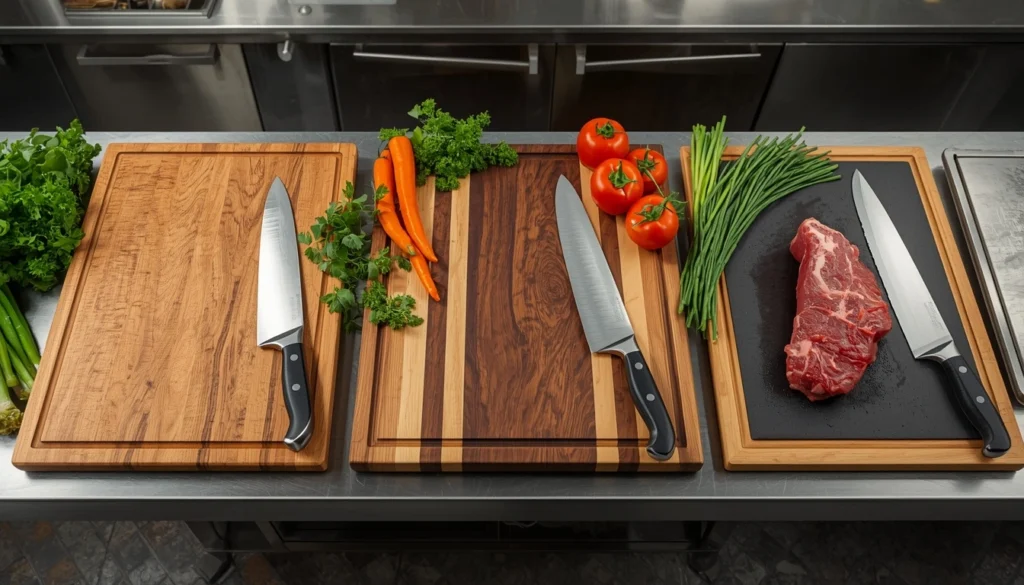
Professional chefs most commonly use end-grain wood cutting boards. Particularly maple and walnut, along with rubber boards for precision knife work. These two materials dominate real professional kitchens. It’s because they protect knife edges, resist bacteria when properly maintained, and hold up under heavy daily use.
Wood and rubber share one critical trait that separates them from every other material: they give a little when a knife blade hits them. That slight give is what keeps an edge sharp over time. Hard surfaces, glass, ceramic tile, and metal do the opposite. They chip and dull blades fast.
Why Wood Is Still the Top Choice
End-grain wood boards are the gold standard for one key reason:
The wood fibers run vertically, so the knife slides between them rather than across them. When you lift the blade, the fibers spring back. This self-healing quality means the board resists deep grooves, and deep grooves are where bacteria hide and knife edges catch.
The science backs this up. Maple cutting boards exhibited a significant reduction in E. coli detection rates to near the detection limit within two hours, without cleaning. HDPE plastic boards presented higher detection rates. Source: ScienceDirect
Hardwoods also bring natural chemistry to the fight against bacteria. Wood fights back against bacteria through tight grain structures that trap bacteria beneath the surface where they die off. Plus there’s the presence of natural antimicrobial compounds like tannins in cherry or juglone in walnut. Source: Wholesale Cutting Boards
For a deeper look at how different wood types compare, our guide on the best wood for cutting boards breaks down maple, walnut, teak, and more side by side.
The best woods for professional cutting boards are:
- Maple — Hard, tight-grained, naturally antibacterial, the most common choice in professional kitchens
- Walnut — Slightly softer than maple, gentler on knife edges, beautiful dark grain
- Teak — Dense and moisture-resistant, excellent for boards near water
- Acacia — Durable and sustainable, though slightly harder on blades than walnut
For my style of cooking, I have used maple occasionally. I enjoy a naturally antibacterial surface that is easy on my knife’s edge. As a chef I can cook a variety of dishes and many of them are not native to my country. I enjoy cooking a wide range of different meats and vegetables. The maple cutting board does not disappoint me in any cooking situation. I like it’s weight, durability, antibacterial properties and the look of the grain.
When Chefs Reach for Rubber Instead
Rubber cutting boards are the quiet professional’s choice. Most home cooks have never heard of them, but they are extremely common in serious restaurant kitchens. Rubber cutting boards are usually what you will find in professional kitchens. They are porous like wood and rank the best when looking at ease on a knife’s edge. Source: Gear Patrol
Sushi chefs in particular rely on rubber boards. The slightly cushioned surface provides exactly the feedback and precision needed for fine knife work with Japanese blades. Butchers also use them for similar reasons, they want a surface that absorbs the force of heavy cuts without pushing back hard against the blade.
Sani-Tuff cutting boards are made from a high-density rubber compound that is very forgiving on knives. It is treated to inhibit the growth of bacteria and fungi, and certified by the National Sanitation Foundation. Source: Gear Patrol
The main tradeoff: rubber boards are heavy, expensive (often over $100), and not dishwasher-safe. They are a performance tool, not a display piece.
What Cutting Board Does Gordon Ramsay Use?
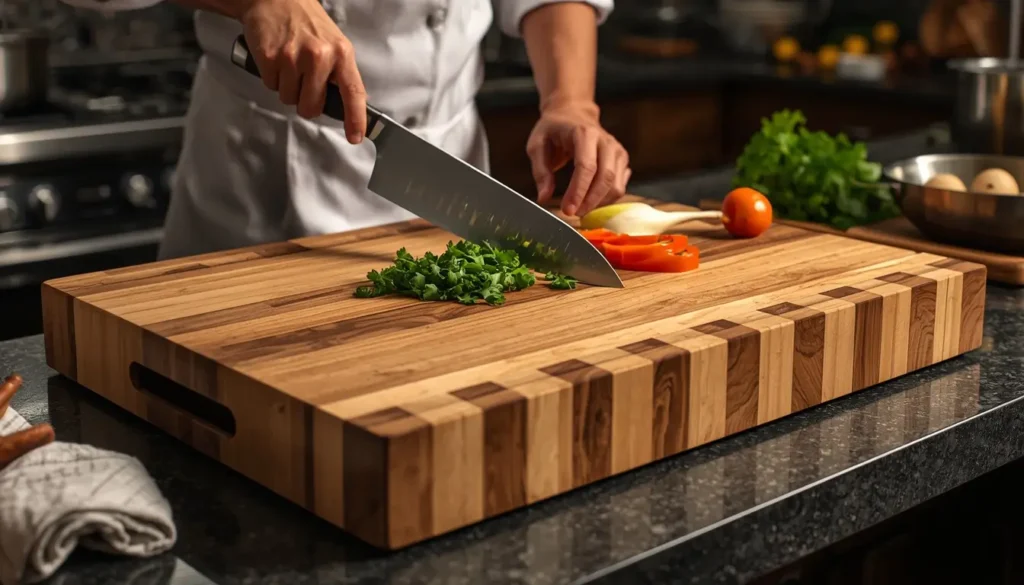
Gordon Ramsay uses a John Boos Block wooden cutting board. It recommends a maple board at a minimum size of 24″ x 18″. This is documented in his MasterClass cooking series and referenced across culinary publications.
The board Gordon uses is a Boos Block. He recommends any large wooden cutting board that is at least 24″ x 18″ in size and not prone to slipping. Source: MasterClass
The John Boos Block — What It Is and Why Chefs Love It
John Boos has been making cutting boards in the United States since 1887. Their boards are made from hand-selected Northern Hard Rock Maple. This maple is one of the densest and most durable hardwoods available for food prep. Boos Blocks are butcher block styled chopping boards made in the USA. They are high quality sustainably sourced, hand-selected Northern Hard Rock Maple Wood. They do not slip around and last a long time. Source: Smartblend
Ramsay has spoken directly about why he prefers heavy, thick wooden boards. In a widely shared video, Ramsay stated: “For brunch, one of the most useful things is a great chopping board. Get the right one and it will be your friend for life. I prefer a sort of heavy-duty one because they are so much more durable. Wooden boards, for me, are always the best.” Source: Bambusi
What makes a Boos Block worth the investment:
- Made from end-grain or edge-grain Hard Rock Maple
- Naturally resists warping, cracking, and staining
- Large enough (24″+ x 18″+) to work comfortably without ingredients falling off the edge
- Heavy enough to stay stable while cutting, no slipping, no chasing the board around the counter
- Can be flipped over to use both sides, extending the life of the board
The most important cutting board feature professional chefs agree on is size. A board smaller than 18″ x 12″ forces you to work in tight quarters, which slows prep and increases the chance of accidents.
What Is Bobby Flay’s Favorite Cutting Board?
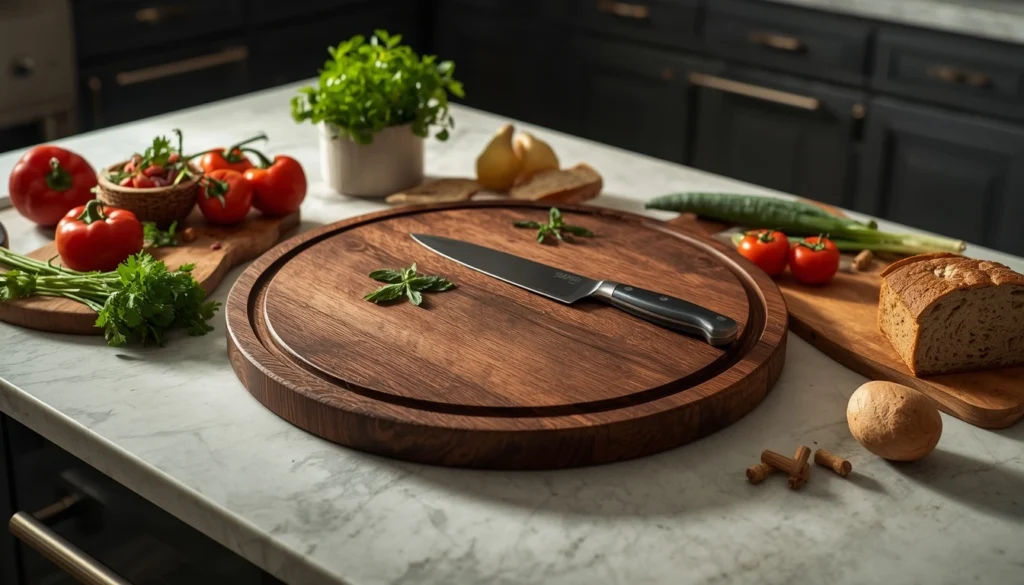
Bobby Flay’s favorite cutting board is a John Boos walnut block. An 18-inch round, 3-inch thick end-grain walnut board. He uses it in his home kitchen and has spoken about it publicly on many occasions.
Bobby Flay’s Walnut Boos Block
Bobby Flay said: “I love my Boos Block cutting board. It is the centerpiece in my kitchen. The only problem is that all my cooks want one now. It is the most durable cutting board that I have ever used. The way my knife reacts to the wood and the product makes the most precise cuts.” Source: John Boos Official Partnerships
He went further in a separate interview:
Bobby Flay refers to his walnut Boos board as “a piece of furniture but utilized as a cutting board” that is “absolutely gorgeous.” Source: Tasting Table
The choice of walnut over maple is deliberate. Walnut sits slightly lower on the hardness scale than maple, which means it is even gentler on knife edges. For a chef who uses precision blades daily, that softness matters. You can read more about the differences between these two woods in our walnut cutting board guide.
It is worth noting that Ramsay and Flay are not outliers here. Ina Garten and Giada De Laurentiis also rely on Boos Blocks. These boards are not just for cutting and slicing, they also work as platters for cheese and charcuterie. Source: Tasting Table
Do Professional Chefs Use Titanium Cutting Boards?
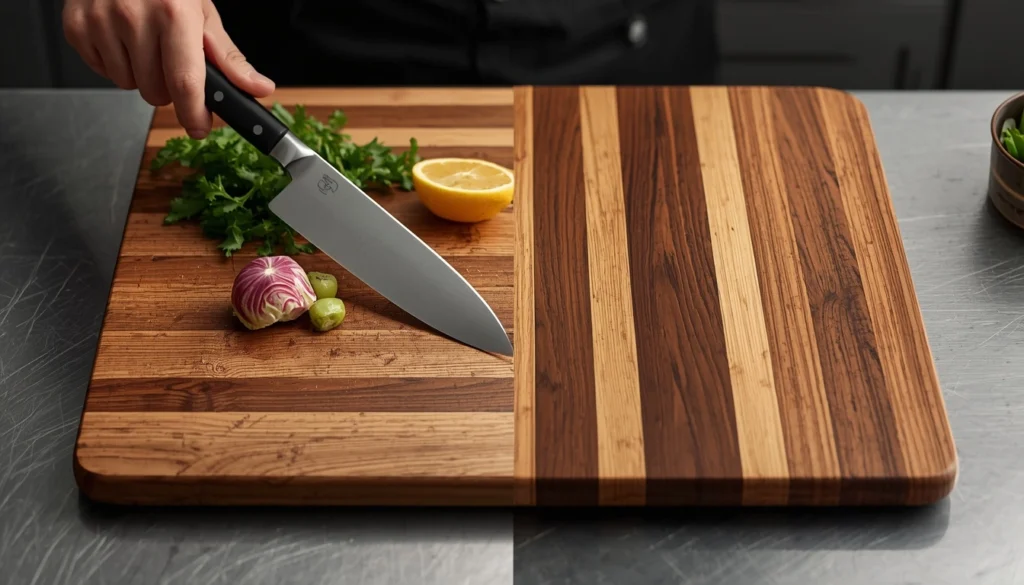
No, titanium cutting boards are not a standard tool in professional kitchens. Despite heavy marketing and social media buzz, the culinary expert consensus is clear. Titanium and other hard metal surfaces are not good for knife edges and are not what working chefs reach for.
What the Experts Actually Say About Titanium
Despite marketing to the contrary, you will never see a professional chef use a titanium cutting board for actual cutting. This is also true for glass and other hard cutting surfaces. If you have expensive knives, you do not want to abuse them by using a titanium cutting board. Source: The Rational Kitchen
The problem is hardness. Titanium is a metal, and metal surfaces, no matter how smooth, do not give when a blade hits them. That resistance translates directly into blade damage over time. The edge deflects, chips microscopically, and dulls faster than it would on wood or rubber.
This is the same reason glass cutting boards are universally rejected by professional chefs. You can learn more about why hard surfaces are a problem for blades in our article on glass cutting boards and knives.
Some professional chefs are interested in titanium cutting boards. It’s because these are non-porous, durable, and easy to clean. However, whether titanium is the right choice depends on hygiene needs, knife feel, workflow, and budget. Source: Y Titanium Cutting Board
The main reason I boast about titanium cutting boards is it’s hard, smooth impenitrable surface. Its very easy to clean, so cross contamination is minimal. This board can handle hard knife impacts, without getting grooves or cuts where bacteria can hide. So definately a useful board to have when preping meals for sensitive people with allergies. I will not use it for all my food prep because of it’s impact on knives. But there is definately a space for a titanium cutting board in my profession.
Where Titanium Boards Do Make Sense
Titanium is not useless, it is just not the right tool for heavy daily cutting. Here is where it legitimately earns a place in the kitchen:
- Food display and serving — Non-porous, easy to wipe down, looks sharp on camera or at the table
- High-hygiene environments — Medical-adjacent or allergy-specific prep where zero porosity matters
- Light tasks — Slicing bread, cutting cheese, tasks where knife contact is minimal
- Durability over blade protection — Cooks who do not use premium knives and focus on a board that will never warp or crack
In summary, professional chefs may choose titanium for its durability and hygiene in specific contexts. However, wood remains popular due to its knife-friendly surface and aesthetic appeal. Source: Cooking Panda
For a full breakdown of titanium board pros, cons, and whether the investment is worth it. Read our dedicated guide: are titanium cutting boards any good?
If you need a zero-porosity board strictly for serving or light tasks, check out a Pure Titanium Cutting Board.
What Material Do Chefs Recommend and Why It Matters for Your Knives
The material of your cutting board directly affects how long your knife stays sharp. This is the single biggest factor professional chefs weigh when choosing a board. It is the reason certain materials dominate professional kitchens while others rarely appear.
The Materials Ranked by Knife-Friendliness
| Material | Knife Impact | Hygiene | Durability | Best For |
|---|---|---|---|---|
| Rubber (natural) | Excellent — softest on edges | Very good — antimicrobial | Excellent | Precision knife work, sushi, butchery |
| End-grain wood | Excellent — self-healing fibers | Good — natural antibacterial | Very good | All-purpose professional prep |
| Edge-grain wood | Good | Good | Good | Everyday home use |
| Plastic (HDPE) | Fair — dulls faster than wood | Good — dishwasher safe | Fair | Color-coded food safety, high volume |
| Composite | Fair to poor | Good | Very good | Heavy-duty prep, high volume |
| Titanium / Glass | Poor — damages edges quickly | Excellent | Excellent | Display, light serving tasks only |
[Source for knife impact ratings: Gear Patrol, The Rational Kitchen, Koppenhouse]
The message from this table is consistent with what every culinary expert says: the softer and more forgiving the surface, the better it is for your knife. Rubber and end-grain wood win because they absorb the blade rather than fighting it.
Why Color-Coded Plastic Still Has a Place
Professional commercial kitchens almost always have a full set of color-coded plastic boards alongside their wood or rubber boards. This is not because plastic is better. It is because food safety regulations need cross-contamination controls.
Commercial kitchens often rely on color-coded plastic boards to keep proteins and produce separate. This approach reduces the risk of cross-contamination. These boards are lightweight, dishwasher safe, and can be easily replaced when worn. This makes them a practical choice for high-volume cooking. Source: Sur La Table
The standard color system most commercial kitchens follow:
- Red — Raw meat
- Yellow — Raw poultry
- Blue — Raw fish and seafood
- Green — Fruits and vegetables
- White — Dairy and bread
- Brown — Cooked meats
For more on how this system works in practice, see our guide on color codes for cutting boards.
How to Choose the Right Cutting Board Like a Pro
Choosing a cutting board the way a professional does comes down to three questions: What are you cutting, what knives are you using, and how important is hygiene control in your kitchen?
If you use quality knives and cook daily: Go with an end-grain maple or walnut board. A size of 18″ x 12″ minimum, 20″ x 15″ or larger if your counter space allows. Oil it monthly with food-grade mineral oil. This is what Ramsay and Flay use, and it is the right call for anyone serious about cooking.
If you do a lot of precision or Japanese knife work: Consider a rubber board for your primary work surface. The Sani-Tuff brand is the professional standard. Expensive upfront, but it protects your investment in quality blades.
If you cook for a family and need easy sanitation: A thick HDPE plastic board for meat and a wood board for everything else is the practical combination. Use the plastic for raw proteins and run it through the dishwasher. Use the wood for everything else and hand wash it.
If someone is trying to sell you a titanium board: Know what you are buying. It will look great on the counter and wipe down easily. But use it for light tasks and keep your good knives away from it for daily prep.
FAQ
What do professional chefs use as a cutting board?
Most professional chefs use end-grain wooden boards made from maple or walnut for general prep work. Rubber cutting boards are also common in fine dining and sushi kitchens. Color-coded plastic boards appear in commercial kitchens for food safety and cross-contamination control.
What chopping boards do professional chefs use?
The most used brands among professional chefs are John Boos Blocks (maple and walnut), Sani-Tuff rubber boards (NSF-certified), and high-density polyethylene plastic boards for color-coded safety systems. John Boos is the most publicly endorsed, with Ramsay, Flay, Ina Garten, and Giada De Laurentiis all on record using them.
What kind of cutting board do pro chefs use?
Pro chefs use thick, large, heavy boards, not thin flexible ones. Size (18″x12″ minimum), weight (stability matters), and material (wood or rubber) are the three things they prioritize. A board that slides around or is too small to work comfortably on is a liability in a fast-paced kitchen.
Are titanium cutting boards good for knives?
No. Titanium is a hard metal surface that does not give under a blade, which leads to faster dulling and edge damage over time. Culinary experts advise against using titanium boards with quality knives. If you own one, use it for light tasks or serving, not daily prep.
What size cutting board do professional chefs use?
Gordon Ramsay recommends a minimum size of 24″ x 18″. Most professional chefs work on boards that are at least 18″ x 12″ for everyday prep, and larger for butchery or high-volume work. Bigger is almost always better, more workspace means fewer accidents and faster prep.
Is rubber better than wood for a cutting board?
Rubber is actually slightly better for your knife edges than even end-grain wood. The difference is small, but rubber is the top choice of sushi chefs and knife enthusiasts for exactly that reason. The tradeoff is that rubber boards are heavier, more expensive, and not dishwasher-safe. For most home cooks, end-grain wood is the better all-around choice.
Conclusion
The answer to what cutting board professional chefs use is not complicated. But it is specific: end-grain maple or walnut, large and thick, from a quality brand like John Boos. For precision work, rubber. For food safety in a multi-protein kitchen, color-coded plastic on the side.
What chefs do not use for serious daily prep: glass, ceramic, or titanium. These look impressive and clean up easily, but they will dull your knives faster than anything else on the market.
The actionable takeaway for most home cooks is this: if you are still using a thin plastic board for everything. Replace it with an end-grain wood board at least 18″ x 12″ in size. Oil it once a month. Treat it like the tool it is. Your knives will last longer, your prep will feel better, and you will be cooking the way professionals actually cook.
Your next step: check what you are currently using and measure it. If it is smaller than 18″ x 12″ or made from a hard material, that is the place to start upgrading.