
Key Takeaways
- Verify the material first. Most boards sold as “titanium” use a titanium coating over a base material. Look for “100% pure titanium” in the product description before spending money.
- Titanium boards do dull knives faster than wood. After 100 cuts with identical chef’s knives. Titanium boards required resharpening 40% sooner than end-grain wood boards. Although they did outperformed plastic by 25%.
- Surface texture matters as much as the material itself. A slightly textured surface gives your knife grip and keeps food in place. A mirror-polished surface looks nice but is slippery and harder to use safely.
- Titanium’s real enemies are hydrofluoric acid and concentrated reducing acids, not everyday kitchen use. Avoid bleach-based cleaners and fluoride compounds. Warm soapy water is all you need.
- You do not oil a titanium cutting board. Oiling applies only to wood and bamboo. Titanium is non-porous and needs no conditioning at all.
Introduction
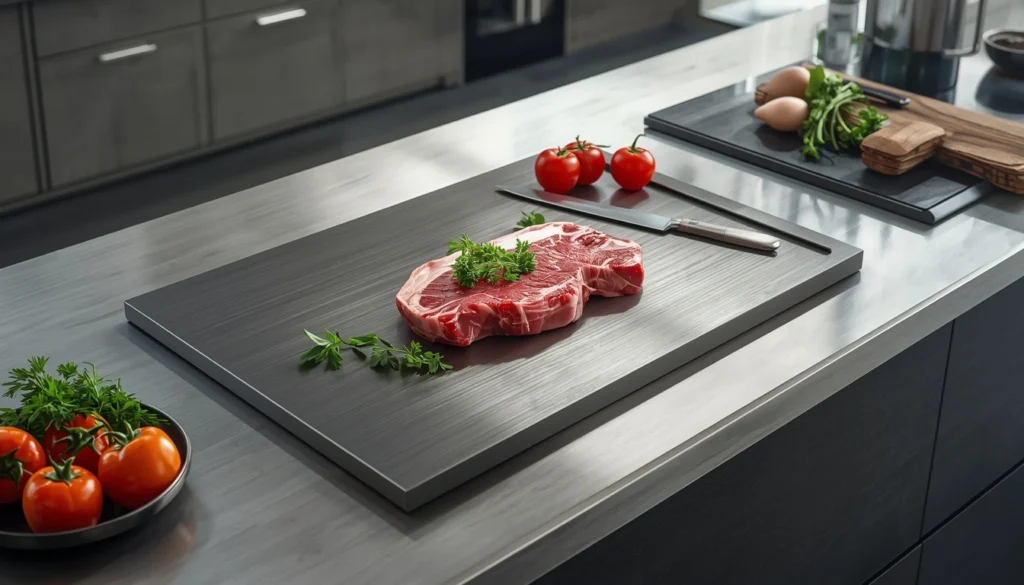
About 90% of home kitchen cutting boards are wood or plastic. Yet titanium boards have carved out a growing following among cooks. These cooks want a surface that never warps, never needs oiling, and can outlast every other board they own. Source: Strabella Home & Kitchen
The problem is that the titanium board market is full of confusion. The word “titanium” gets applied to products that are coated steel, coated aluminum, or titanium-infused composites. The price range runs from $15 to over $400, and nothing on the packaging tells you clearly what you are actually buying.
This guide walks through exactly what to look for in a titanium cutting board. You’ll learn how to choose one that fits how you cook, what titanium’s real weaknesses are, and the safest oils for any wood boards you keep alongside it.
What to Look For in a Titanium Cutting Board
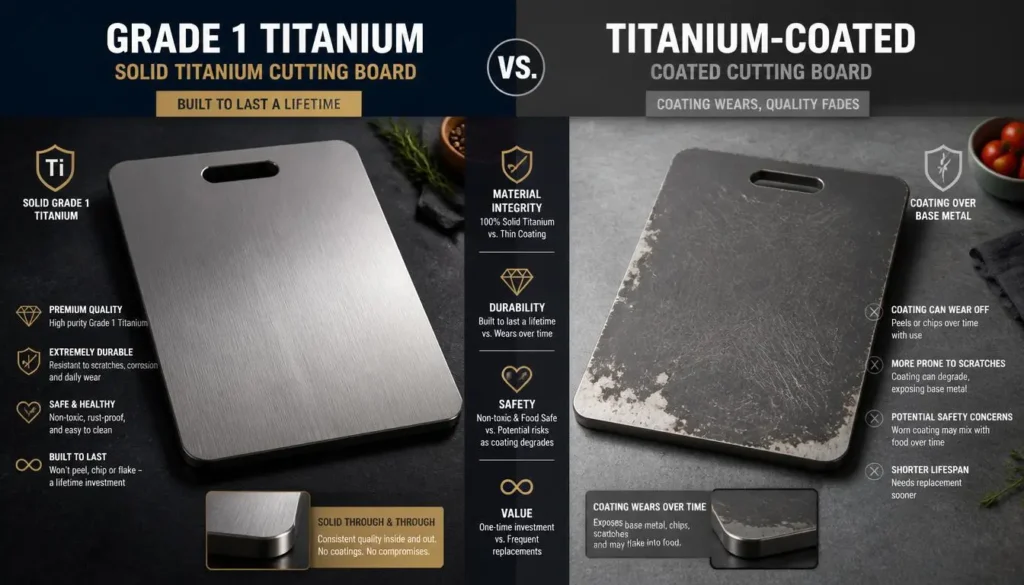
The single most important thing to know before buying: most boards marketed as titanium are not solid titanium. Source: Taimir Cutting Board Blog Understanding this upfront will save you from paying a premium price for a coated surface. The kind of surfaces that may chip or delaminate within a year.
Pure Titanium vs. Titanium-Coated Boards
True solid titanium boards are made from commercially pure titanium. Usually Grade 1 or Grade 2, the same quality used in medical implants and aerospace parts. These are non-reactive, FDA-compliant, and built to last for decades. Source: Taimir Cutting Board Blog
Most budget options use a titanium nitride (TiN) coating sprayed over a base material like stainless steel or aluminum. The coating looks and feels similar in the store, but over time it can wear through, chip, or scratch. Once it does, you are cutting on whatever sits underneath.
Here is what to check before buying:
- The description should say “100% pure titanium” or specify the grade (Grade 1 or Grade 2). Vague terms like “titanium-infused” or “titanium-enhanced” almost always signal a coated product. Source: Taimir Cutting Board Blog
- Any solid titanium board priced under $50 is not solid titanium. Genuine boards start at $150 and typically run $200–$400 for commercial-grade options. Source: Strabella Home & Kitchen
- Lower-quality boards may also have inconsistent surface finishes and thinner construction. These features affect how they hold up after repeated cutting over time. Source: Y Titanium Cutting Board
Size and Thickness
Getting the right dimensions right matters more than most buyers expect.
Here’s what you need for everyday family meal prep. A medium-to-large board in the 12–16 inch range. This gives you enough room to chop vegetables, slice proteins, and move ingredients around without crowding. Source: Taimir Cutting Board Blog A small board in the 8–10 inch range works well for outdoor cooking, camping, or van kitchens. Titanium’s strength-to-weight ratio makes a small board surprisingly capable for travel use. Source: Titanium Cutting Board Buying Guide
On thickness, thicker boards are more durable and resist warping under heavy chopping tasks, but they add weight and are less portable. Thinner boards are easier to handle but can flex and shift during cutting, which is a safety hazard. Source: TitanCuttingBoards A minimum of 3mm thickness is a reasonable baseline for daily kitchen use.
If you use high-end chef’s knives. The thickness of your board also affects impact absorption, something we cover in our guide to the benefits of thick boards for chef knives.
Surface Texture and Knife Friendliness
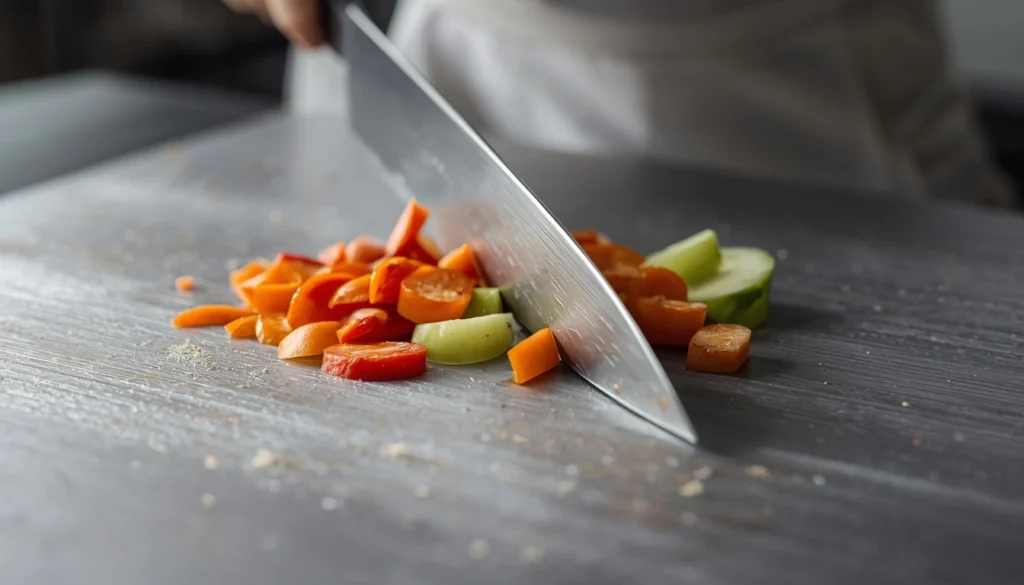
The best titanium cutting boards have a slightly textured surface. Not rough, not mirror-smooth, a gentle texture that gives your knife blade a little grip during cutting and stops food from sliding around. Source: Taimir Cutting Board Blog
A fully polished surface sounds like a premium feature but creates two real problems. It is slippery for both your food and your knife, and it makes the metallic “ping” sound of each cut sharper and louder. Strabella Home & Kitchen’s testing recorded that sound at 65–70 decibels on polished titanium surfaces. It was like a normal conversation level but harsher than the 45–50 decibels of quality wood boards. Source: Strabella Home & Kitchen
On knife wear, titanium boards dull knife edges faster than wood. The metal surface does not absorb the impact of each cut the way end-grain wood does. Testing by Strabella showed that knife edges required resharpening 40% sooner after 100 cuts on titanium. Put that versus end-grain wood, while titanium still outperformed plastic boards by 25% in the same test. Source: Strabella Home & Kitchen
Titanium is still far gentler than glass, marble, or ceramic boards, all of which cause rapid edge damage and can chip blade tips. For a full comparison of how surfaces affect blade life. See our article on knife mark resistance in cutting boards.
[If your knives are your biggest kitchen investment, use titanium for serving and raw protein prep, and keep a hardwood board as your daily cutting surface to protect your edges.]
Non-Slip Base and Juice Grooves
Two design features separate a well-made titanium board from a basic one:
Non-slip base. A smooth, relatively heavy metal board with no grip will slide on your counter under chopping pressure. That is a real safety issue. Look for silicone feet, a rubberized underside coating, or a textured bottom surface. Source: TitanCuttingBoards
Juice grooves. If you plan to use the board for meat, poultry, or fruit, perimeter juice grooves keep liquids on the board rather than running onto your counter. Without them, runoff creates both a mess and a cross-contamination risk. Source: Taimir Cutting Board Blog
These features carry across materials too. Our guide on what cutting board material would be best for chef knives covers how design factors affect both performance and safety.
Price as a Quality Signal
With titanium boards, the price gap between product tiers actually tells you something real:
Price Range What You Are Usually Getting Under $50 Coated board (TiN on steel or aluminum base) $50–$150 Higher-quality coated boards or titanium-composite hybrids $150–$400+ True solid titanium (Grade 1 or Grade 2) $200–$400 Commercial-grade solid boards used in professional kitchens
Source: Strabella Home & Kitchen
A coated board bought cheap may chip or scratch within months. A genuine solid titanium board, maintained correctly, can last 10+ years with zero seasoning or conditioning required. Source: Strabella Home & Kitchen The lifetime value case for real titanium is strong. Especially if you are serious about not replacing boards every year or two.
How to Choose a Titanium Cutting Board for Your Kitchen
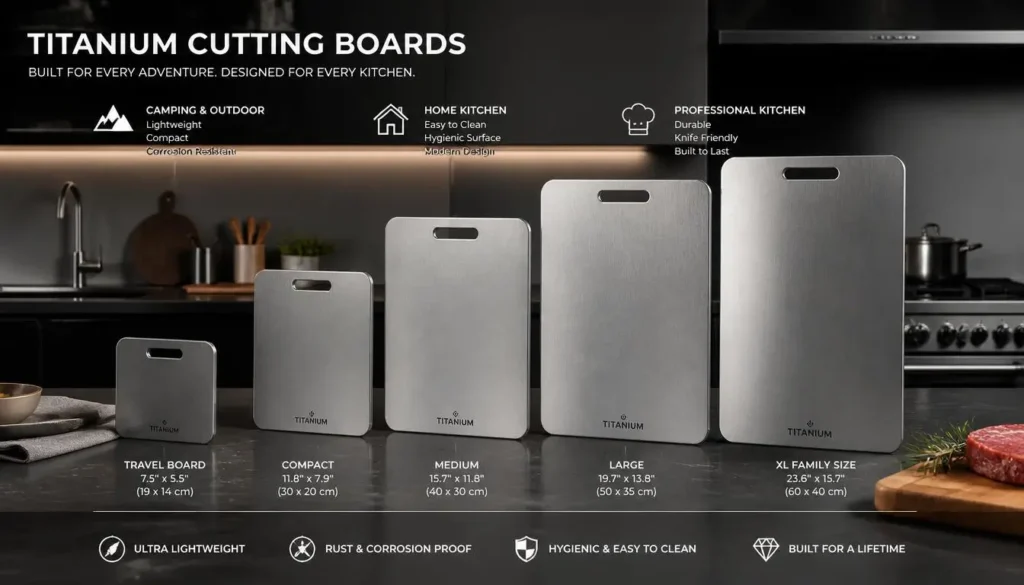
Knowing what features to look for is half the job. The other half is matching those features to how you actually cook.
For Everyday Home Cooking
A mid-to-large solid titanium board (12–16 inches) with a non-slip base and juice grooves handles most daily prep tasks well. The real selling point for home cooks is the zero-maintenance routine, no oiling, no resurfacing, dishwasher-safe cleanup after handling raw meat or fish. Source: SiraatKitchen.com
The change to make is knife care. Plan to hone your edges more regularly if titanium becomes your primary prep surface. Many everyday cooks find the best setup is a two-board system. Titanium for anything raw and high-hygiene, and a hardwood board for daily vegetable prep where knife life matters more.
For Outdoor and Travel Use
This is where titanium earns its strongest recommendation. Compared to stainless steel boards, titanium boards are roughly 40% lighter. This makes a meaningful difference when you are packing a bag or setting up a van kitchen. Source: Titanium Cutting Board Buying Guide Titanium also does not warp in humidity, does not rust, and cleans up with a quick rinse. It is far more practical outdoors than wood or composite boards.
For outdoor use, focus on a compact size (8–10 inches), a non-slip surface on both sides for use on rough terrain. Also a carrying sleeve to prevent scratches in your pack.
For Professional or High-Volume Prep
In commercial kitchens, the standard cutting surface is still plastic poly boards or wood. Simply because of knife-friendliness and cost at scale. That said, a titanium board makes strong sense in a professional setting for specific tasks. Example breaking down raw proteins where deep sanitization matters, or as a presentation board where appearance is part of the service. Source: Strabella Home & Kitchen
Commercial-grade titanium boards justify their $200–$400 cost. Also look at zero maintenance, health department compliance, and lifespans of 10+ years with no replacement needed. Source: Strabella Home & Kitchen
For a full breakdown of what surfaces professionals actually prefer. See our article on what cutting board do professional chefs use.
What Is the Enemy of Titanium?
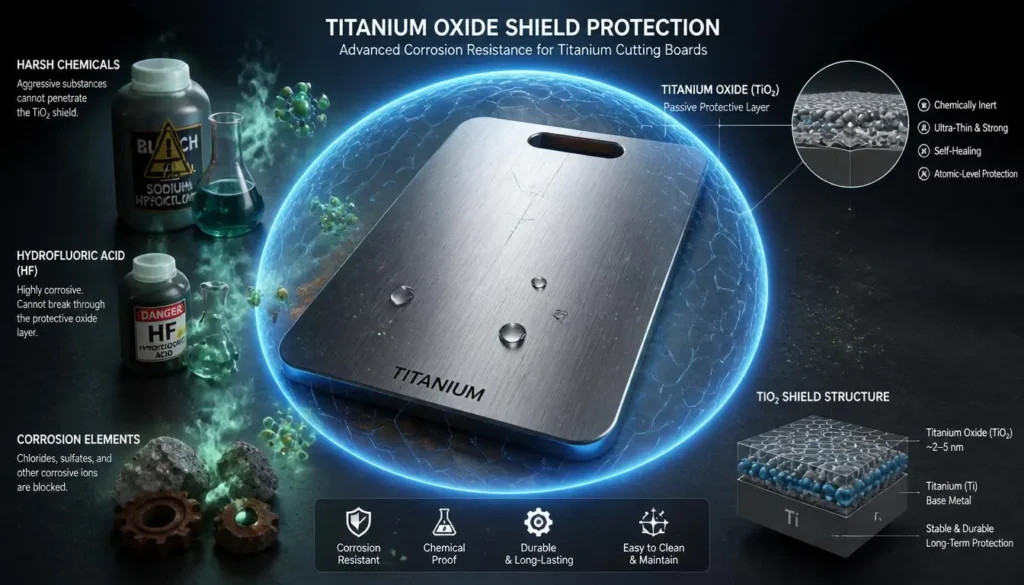
Titanium is one of the most corrosion-resistant metals used in engineering. “The instant titanium contacts oxygen or moisture, it forms a stable, self-repairing oxide layer (TiO₂) on its surface. It’s a passive film just 2–7 nanometers thick that acts as a shield against chemical attack. In most environments, including seawater, chloride atmospheres, and human body fluids. Titanium remains virtually unaffected even after decades of exposure. Source: Crnmc.com — Corrosion Resistance of Titanium
So what can actually damage it? The answer is narrower than most people expect.
Harsh Chemicals and Concentrated Acids
Titanium’s primary documented weaknesses are susceptibility to attack by anhydrous chlorine, hydrofluoric acid, and concentrated reducing acids. Also with material degradation above 600°C. Source: Crnmc.com . None of these conditions exist in a normal home kitchen.
However, the practical takeaway for kitchen use is this. Avoid bleach-based cleaners, fluoride-containing compounds, and harsh chemical sanitizers on your titanium board. Fluorides and hydrogen peroxide deteriorate the titanium dioxide film that protects the surface. If that protective layer is damaged repeatedly. The base material becomes vulnerable.
For day-to-day cleaning, warm water and mild dish soap are everything you need. Titanium is non-porous, so bacteria cannot penetrate the surface. You are cleaning the top layer, not trying to disinfect deep grain or grooves the way you would with a scarred plastic or wood board. Source: ChopChop USA
Metal-on-Metal Friction and Your Knives
The other enemy of titanium in a kitchen context is not chemical, it is friction. Every time a knife edge contacts a titanium surface, the board does not flex or compress the way wood does. That impact transfers directly to the blade’s fine edge, gradually rolling and flattening it. Source: SiraatKitchen.com
This is not a defect unique to titanium, every cutting surface dulls knives eventually. But titanium accelerates it more than wood or plastic, and less than glass or marble. Knowing this going in helps you plan your board rotation and sharpening schedule rather than being caught off guard.
For more on how titanium compares to other surfaces on blade life, see our article on do titanium boards dull knives.
What Kind of Oil Is Safe to Use on a Cutting Board?
The short answer for titanium: none needed. Titanium is non-porous, does not absorb moisture, does not dry out, and does not develop the surface cracks that make wood boards unsafe over time. No oiling, no conditioning, no waxing. Just wash and dry. Source: Taimir Cutting Board Blog
If you own wood or bamboo boards alongside your titanium board, which most titanium board owners do. The question becomes very relevant for those surfaces.
Food-Grade Mineral Oil: The Standard Choice
Food-grade mineral oil (also called liquid paraffin) is the most widely recommended oil for wooden cutting boards. It is non-toxic, colorless, odorless, and never goes rancid. A gold standard for conditioning wood that is in daily contact with food. Source: CuttingBoard.com
The key word is food-grade. Mineral oil sold in hardware stores and auto shops is used as a machinery lubricant and is not safe for food contact. Any product labeled “white mineral oil” has been refined to FDA food-safe standards. Source: CuttingBoard.com Always check the label before buying.
Regular mineral oil application prevents wood from drying out and cracking. It also creates a moisture barrier that stops liquids and bacteria from penetrating the wood’s pores. Source: CuttingBoard.com For daily-use boards, reapplication roughly once a month is a reasonable target.
Other Safe Options
Beeswax (combined with mineral oil) is a popular pairing that adds a protective wax layer on top of the oil’s moisture barrier. The wax fills small knife cuts and imperfections and reduces how often you need to re-oil. Source: CuttingBoard.com You can buy ready-made blends or make your own with 1 part beeswax melted into 4 parts mineral oil.
Fractionated coconut oil is a fully plant-based alternative. Regular coconut oil goes rancid over time. But fractionated coconut oil has had the long-chain fatty acids removed through a distilling process. This makes it shelf-stable and resistant to oxidation. Source: Hardwood Lumber Company It is a solid pick for cooks who prefer non-petroleum-based products.
Oils to Avoid Completely
Never use standard cooking oils on a wood cutting board. Olive oil, vegetable oil, canola oil, and regular coconut oil are all unstable when exposed to air repeatedly. They turn rancid, leave a foul smell, and deposit a sticky residue that is near to impossible to remove without sanding the board down. Source: Hardwood Lumber Company This is one of the most common cutting board mistakes home cooks make.
For a full walkthrough of how to condition and maintain a wood board, see our guide on how to oil a cutting board.
FAQs Before Buying Titanium Cutting Board
Is a titanium cutting board safe for food contact?
Yes. Titanium is completely food-safe and is widely used in medical implants, surgical tools, and food processing equipment. It is non-toxic, non-reactive, and does not leach chemicals into food under any normal kitchen conditions. Source: Taimir Cutting Board Blog For cooks who worry about material safety, titanium is one of the cleanest choices available.
Can you put a titanium cutting board in the dishwasher?
Most solid titanium boards are dishwasher-safe. Unlike wood, titanium does not warp, crack, or degrade from repeated exposure to heat and moisture. Source: SiraatKitchen.com Always check the manufacturer’s instructions for any boards with silicone feet or rubber bases. Those attachments may degrade in the dishwasher faster than the board itself.
How long does a titanium cutting board last?
A genuine solid titanium board can last decades with basic care. Plastic boards typically need replacing every 6–12 months, and wood boards every 1–3 years with proper maintenance. Source: Taimir Cutting Board Blog Commercial titanium boards in high-volume kitchens routinely last 10+ years with no seasoning, resurfacing, or replacement required. This offsets the higher upfront cost over time.
What is the difference between a titanium and a stainless steel cutting board?
Titanium is lighter than stainless steel, roughly 40% lighter for the same board size, and is gentler on knife edges. Source: Titanium Cutting Board Buying Guide Stainless steel boards are heavier and more stable on the counter. But the harder surface dulls blades faster. Titanium also has superior corrosion resistance and is fully biocompatible. Meanwhile stainless steel may contain nickel or chromium that can be a concern for sensitive individuals. For a full head-to-head, see our article on titanium vs. stainless steel vs. wood — which cutting board wins.
Should titanium be my only cutting board?
For most cooks, no, a two-board system works better. Use a hardwood board (maple, walnut, or teak) as your primary daily prep surface to protect knife edges. Reach for the titanium board when hygiene is the top priority: raw meat, raw fish, or poultry. Source: Medium/Mini-Mind-Blows This approach protects your knife investment. At the same time giving you a board that handles your highest-hygiene tasks without hesitation.
Conclusion
Buying the right titanium cutting board comes down to four decisions:
- Confirming you are getting true solid titanium and not a coated surface.
- Picking the right size for how you cook.
- Making sure the board has a non-slip base and juice grooves.
- Accepting the knife-dulling trade-off going in.
Titanium is not the right primary board for everyone. If knife longevity is your top priority, a quality hardwood board still wins for daily prep. But for cooks who want a hygienic, zero-maintenance surface that holds up to raw proteins and lasts for decades. A genuine solid titanium board is a strong long-term investment.
Your next step: If you are still comparing materials before committing. Read our full breakdown of what is the healthiest cutting board material. You’ll see how titanium stacks up against wood, plastic, bamboo, and composite boards on hygiene, safety, and durability.